
Guide to Self-Driving Uganda
Uganda, often called the “Pearl of Africa,” is one of the most beautiful and diverse safari destinations in East Africa and Africa at large. From mist-covered mountains and lush tropical rain forests to sprawling savannah grasslands and the mighty River Nile, Uganda offers every kind of adventure a traveler could dream of. One of the most exciting and affordable ways to explore this spectacular country is through a self-drive safari — where you take the wheel and experience the freedom of Africa’s wild landscapes at your own pace.
This article – Self-Drive Safari Guide to Uganda, will help you understand everything you need to know: from planning your route and choosing the right vehicle to obtaining park permits, safety tips, and the best national parks to visit.
Why choose a self-drive safari in Uganda
A self-drive safari in Uganda is all about flexibility, adventure, and independence. You get to decide your schedule, where to stop, and how long to stay. You can pause to watch elephants cross the road, stop by a roadside market for fresh fruit, or explore lesser-known corners of the country without rushing.
While guided safaris are great for first-timers, a self-drive safari is ideal for those who love adventure and want to experience Uganda on their own terms.
Best time to go on a self-drive safari
Uganda’s climate is favorable year-round, but the best time for a self-drive safari is during the dry season, that is, June to September and December to February.
During these months, roads are in better condition, and wildlife is easier to spot around water sources. The wet seasons (March–May and October–November) can make some roads muddy, especially in national parks, but they also offer lush scenery, fewer tourists, and discounted lodge rates.
Top national parks for a self-drive safari
- Murchison Falls National Park
Located in the north-western region, Murchison Falls National Park is Uganda’s largest park and one of the most thrilling for self-drivers. During the adventure at the park, watch the Nile River crash through a narrow gorge of 7meters to form the powerful Murchison Falls. Apart from the falls, the park protects numerous wildlife, including elephants, giraffes, lions, buffalo, hippos, and crocodiles.
To have the best viewing experience, take part in adventures like game drives, boat cruise to the base of the falls, and a visit to the top of the falls viewpoint.
- Queen Elizabeth National Park
Known for its scenic landscapes and diverse wildlife, Queen Elizabeth National Park is the second-largest park in Uganda after Murchison. Located in the western region of the country, the park is known for offering classic game drives that expose you to 4 of the 5 big African game – lions, elephants, buffalo, and leopards. Also in the park, enjoy the incredible boat cruise along the Kazinga Channel, where hippos and buffalo line the banks.
Queen Elizabeth National Park also protects some primate species like chimpanzees in its Kyambura Gorge. Still in the park, have a unique sight of the rare tree climbing lions in the Ishasha sector.
- Bwindi Impenetrable National Park
In the south-western region, Bwindi is a UNESCO World Heritage Site and home to more than half of the world’s mountain gorillas. The park protects 4 gorilla trekking sectors – Nkuringo, Buhoma, Ruhijja and Rushaga that provide a close view of endangered mountain gorillas during gorilla trekking experience. While gorilla trekking must be done with a ranger, self-driving allows you to explore the scenic highlands at your own pace before or after your trek.
- Kibale National Park
The primate capital of the world, famous for chimpanzee tracking and rich forest biodiversity. Kibale is an easy drive from Queen Elizabeth National Park, making it a natural stop on a circular safari route. While at the park, take part in adventures such as bird-watching, a forest walk, and primate watching.
- Lake Mburo National Park
Lake Mburo is the closest park to Kampala and perfect for short self-drive safaris. The park features beautiful rolling hills, lakes, and a diverse array of wildlife, including zebras, impalas, elands, and hippos. While at the park, engage in experiences like walking safaris, boat rides, biking, and horseback safaris.
Driving tips and road conditions
- Roads are generally well-maintained highways between major towns, but gravel or dirt roads inside national parks may require a 4×4 vehicle.
- Drive on the left side of the road in Uganda.
- Avoid night driving, as roads can be poorly lit and animals or pedestrians may appear suddenly.
- Speed limits: 50 km/h in towns, 80 km/h on highways.
- Use offline navigation apps like Maps.me or Google Maps.
- Always carry cash, as ATMs are rare in remote areas.
Vehicle hire and equipment
Most car rental companies in Uganda offer fully equipped 4x4s suitable for self-drive safaris. Common models include Toyota Land Cruisers, Hilux Double Cabs, and RAV4s.
Optional equipment:
- Roof-top tent or camping gear
- GPS or offline maps
- Cooler box and cooking set
- Extra fuel and spare tyre
Note: Ensure your vehicle has comprehensive insurance and 24-hour roadside assistance coverage.
Accommodation options
Uganda offers a wide range of accommodations to suit every budget:
- Luxury lodges: Ideal for comfort and scenic views.
- Mid-range lodges & tented camps: Balance of comfort and value.
- Budget camping: Many parks offer campsites for self-drive travelers with basic facilities.
Always book gorilla-area accommodations early, especially during peak seasons.
Safety and travel tips
- Respect park rules — no off-road driving or feeding wildlife.
- Carry a first-aid kit, mosquito repellent, and sufficient drinking water.
- Stay informed about local weather and road conditions before setting out.
- For gorilla and chimp treks, always follow ranger instructions.
- Engage with local communities respectfully and consider community-run lodges or cultural experiences.
Conclusion
A self-drive safari in Uganda offers unmatched adventure, flexibility, and authenticity. From the thundering waters of Murchison Falls to the tranquil misty forests of Bwindi, the experience connects you deeply with nature and the country’s vibrant culture. With proper preparation, reliable navigation, and a spirit of adventure, you can explore Uganda safely and create unforgettable memories on one of Africa’s most beautiful self-drive routes.
Read More
Guide to Gorilla Trekking in Uganda
Around only 1060 mountain gorillas still exist today. Although our closest living relatives, ironically, it is man that poses the greatest threat to their survival. For years gorillas have been ruthlessly hunted for their hands and heads, which are sold on as macabre souvenir ashtrays and lamp shades. Additionally, large numbers have been killed whilst trying to stop poachers stealing babies which are illegally sold on to zoos, where their survival rate is low. This has affected Uganda Safari industry.
Gorilla trekking is a wonderful experience, allowing you the opportunity to have a close encounter with these gentle giants of the jungle in their natural habitat. The trekking will take place either in Uganda, Rwanda or Democratic Republic of Congo – depending on local conditions and the availability of the gorilla permits. You need not feel that you are exploiting these animals by paying good money to go trek to see them in their natural habitat. In fact the ever-growing number of tourists keen to see the gorilla proves to be an important factor in their survival. The gorilla permit fees help to set up and finance patrols that are instrumental in protecting the gorillas from poachers and their lethal snares.
Gorilla Permit Costs
On our African overland safaris, gorilla trekking is an optional activity and the cost of the permit, transfer and local service fee is to be paid upon arrival. We also offer a 4 day Gorilla Express lodge accommodated safari in Rwanda, please note that on this trip the cost of the gorilla permit, transfer and service fee is included.
The cost and availability of gorilla permits varies by country and park and currently ranges from USD 400 – 1500. You will also need to budget for visa fees (costs vary), transfer and a local service fee (approx USD 60 – 75) and to renew your Ugandan or East African visa upon re-entry should we have to go to Rwanda or DR Congo. The government often increases the permit and transfer costs without notice, so we ask that you budget for the highest amount, so that you don’t suddenly have to find additional money to partake in this wonderful experience. We recommend you budget a total of atleast US$ 1200.
The reason that the permits are so costly is because each park only issues 10 permits per gorilla family per day, to ensure that the gorilla’s exposure to humans is limited. 100% of the gorilla permit cost is used by the government to continue in the excellent work they do in protecting and promoting these wonderful animals.
Tours companies are not in control of the price of gorilla permits and therefore cannot be held responsible for any increase in fees. If the political situation in this region should change, there is the chance that the itinerary would be amended and an alternative scenario advised prior to departure if possible.
Trekking to see the Gorillas
The trek starts in the early morning and after border formalities you are transferred to a ranger’s station where the trek commences. Your rangers will lead you through the cultivated lands and then into the dense rain forest and as close as is allowed to a gorilla family. The rangers monitor the gorillas on a daily basis and have a fairly good idea of where they are. However, they are free roaming animals, and their sighting cannot be guaranteed. Trekking can take anywhere from 45 minutes to 8 hours and it can be quite strenuous, so a reasonable level of fitness is required.
To ensure the gorillas do not get too used to the presence of humans and because they share many of our genes (and are therefore able to catch our diseases), the maximum time permitted to spend with them is 1 hour. You will have plenty of time to watch their activity and to take photographs. The rangers will be able to provide you with a background to the family you are visiting. Once your hour is up, you trek back out of the rain forest to your meeting point. Clients considering joining this trip should realize the demands and unpredictability of the areas visited. These factors may contribute toward restricting or delaying our trip and viewing of the gorillas. Often, the trek through thick, dense jungle can be somewhat strenuous and due to the nature of the gorillas and their habits, viewing cannot be guaranteed.
IMPORTANT: Although the groups of gorilla that are sought out on our jungle trek have been habituated, they have not been tamed and their behaviour is not demonstrably different from that of non-habituated groups. Nobody forces them to stay with us for the allotted hour, and they can fade into the forest as you appear, if they wish to do so. Further, as gorillas are EXTREMELY sensitive to human disease, the park authorities will not allow anyone they consider to be in poor health to visit the gorilla groups. Additionally, no children under 16 years of age are permitted to visit.
Read MoreObote and Uganda’s Independence
” At the turning-point in the history of Uganda, I hope that all our friends will join with me in bestowing upon the new, independent Uganda our prayers and hopes for peace, prosperity and a growing strength in her now role in international affairs. Uganda has many friends, both within her borders and outside. With the goodwill of all who wish to see her prosper, Uganda will go forward from strength to strength.
Let us pause for a moment and look back along the path we have traveled. In the days before this part of the African continent was known to the western world, we became known as a group of peoples who welcomed the traveler, the missionary and the explorer. As the years passed, we reaped the benefit of this friendly nature of ours. The technical progress of the last half-century has transformed our country in countless ways. But, fortunately, we have continued to keep our own customs and culture. It is up to us now, more than ever, in shaping our new country, to achieve a consolidation, in which neither the rapid progress of recent years, nor the age-old customs of our forefathers, are lost or diminished, but rather fused into a new national characteristic in which the best is preserved, while the worst may be thrown away.
AN UHURU MESSAGE FROM THE PREMIER
from the Uganda Argus
National unity
What other aims have we, today, on looking forward? One of our first needs must be national unity. The narrow ambitions of a tribe, a sect, or a party must be subordinated to the greater needs of one complete Uganda.
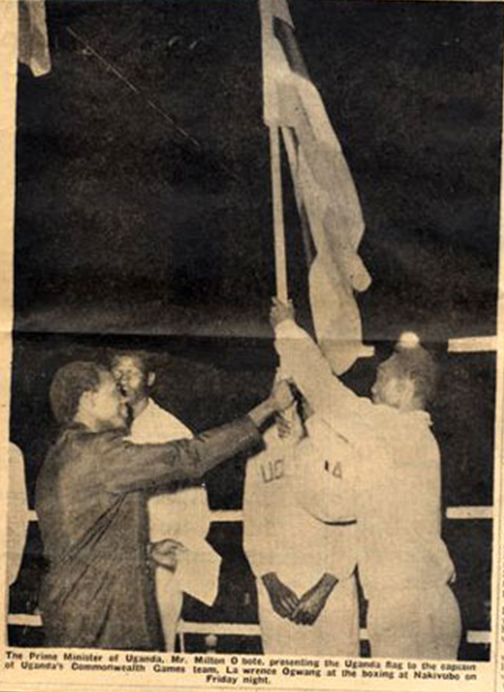 In our Government of these past months, we have striven to put the interests of Uganda before all else, and we shall continue to do so. But on attaining independence, this Government has new responsibilities to bear, heavier than those which any previous government in Uganda has borne, and we are conscious of the care and statesmanship with which we must move in taking our first steps in foreign affairs. In the Commonwealth and in the United Nations we shall be among friendly states, both from other parts of Africa and from elsewhere. But the regard in which a nation is held in the eyes of the world depends upon the successful operation of a complex machinery.
On 9th October, 1962, Uganda becomes an independent sovereign state within the Commonwealth of Nations. H.M. the Queen becomes Queen of Uganda and the Head of State, represented in Uganda by a Governor-General.
Her Majesty is to be represented at the celebrations by H.R.H. the Duke of Kent and the Duchess of Kent who will afterwards make a tour of the Regions.
from the Uganda Independence Souvenir Programme.
We have paid attention to the design of that machinery. First, we require political stability. My Government will seek to maintain that stability, by the strict maintenance of law and order, by retaining the confidence of the voters, and by upholding the freedom of the individual. Secondly, we require to safeguard the economy. This we will do by diversifying and improving our agriculture, providing incentives to industry, and creating conditions which encourage foreign investment. Thirdly, we will press forward with social services within realistic bounds and not as dictated by idealism. Fourthly, we need an efficient civil service to operate the Government. Uganda is well provided with well-qualified African officers and we shall continue to ensure that these are attracted into government service by the offer of the right terms, so that a balanced Africanisation programme shall continue.
I conclude by emphasising that there is a place in the Uganda of today for all who have her interests at heart, whatever their tribe, race or creed. Let all of us, who wish to see Uganda prosper, join together today in resolving to build a great and united nation.”
Read More
Obote: Forming Uganda People’s Congress
The Prime Minister of Uganda
The man who leads the new independent nation was once a labourer on a building site.
Uganda Argus, 1962.
Click Here: Obote: Part 1- The Premier’s Own Story
Highly political
He paused and said: “I decided then that I wanted to enter either law or politics.” This was the first time that he had mentioned politics and I was interested to know just how he first took an interest. The answer is very simple. “My family has always been highly political and I grew up with politics. The fathers of Mr. Obote and his Minister of Information, Broadcasting and Tourism, Mr. Adoko Nekyon, are brothers and their mothers are sisters. And the Prime Minister’s voice took on a rather bitter note, as he recalled the next part of his life story.
“I was offered a scholarship by Lango Local Government to take either a law course or economics, and was offered a place to study law by an American University. The Uganda Government turned it down, because it said American law would be no good for this country. Then I decided to go to London University to study law. This too was turned down by the Government on the excuse, that it was unnecessary expenditure as lawyers were not required in this country. So then I decided to change to economics and was offered a place by Gordon College, Khartoum. That one was turned down by the Government as well – because it said I could not make up my mind, where or what I wanted to study.
Job problem
“Then I gave up and took a correspondence course instead. I studied law, politics and a bit of journalism for a year.” But some good came out of Mr. Obote’s being refused a scholarship, because he went on: “I travelled throughout Lango telling the people of the great injustice I had received from the Government and selling to them the idea that the people of Lango should organise their own independent scholarship fund to award their own scholarships. The fun’s now working well and about 20 scholars have gone abroad on the scheme from money raised by local Government taxes. I kept up correspondence courses until 1957, although I never took any examinations.” But now 26-year-old Obote was faced with a problem, he had to get a job.
Deliberate
And he took one – as a labourer. “This was a deliberate decision,” he told me. “I had become interested in the trade union movement. And I decided the best way to learn more about trade unionism was to start at the bottom”. One of the labourers toiling for Mowlem Construction Company Ltd. building the silo for the grain conditioning plant at Jinja, was the future Prime Minister. And as far as he can remember, his wages were 22/- a month. But for his first job, Mr. Obote went down to Kenya, joined the Kenya African Union and took a labourer’s job at Miwa?? Sugar Works near Kisumu.
18/- a month
“It wasn’t a very good job”, he remembered. “It was very hard work. After three weeks at that I got a job with the treasury in Kisumu. I think I was getting then about 18/- a month. I had to leave the sugar works because there were a lot of Lango there. They objected to the son of a chief and ????? student at Makerere working as a labourer. When I took the job with the treasury I did not reveal my identity and told them I was a junior secondary man.”
After a month with the treasury, Mr. Obote decided to move to Jinja, and although the treasury wanted him to stay on and he did in fact work another fortnight, he then went to Mowlems. This was before the days of trade unions in Uganda, but he began to organise the workers. But he could not conceal his education for long. “After two months the company found I was not an ordinary labourer and promoted me to office work”, he said. “When a labour advisory committee was set up in Jinja, the workers nominated me as a member.
from the Uganda Argus
Too outspoken
“But here I made a mistake. At the first meeting I was a bit too outspoken for the D.C. and we never held another meeting. I thought the wage of 20/- a month were too low and thought I would put their case. But I spoiled it for them”.
By the time Mowlems moved to Jinja Water Works, Milton Obote had been put in charge of all the paperwork, including finance. When Mowlems moved into Kenya to build a reservoir at Kabete, they took Mr. Obote with them. He became active in the K.A.U., but when the Mau Mau emergency was declared in 1952, the party was proscribed and the leaders arrested. And the Prime Minister told me the now famous story of how at Kabete he nearly lost his life at the hands of the Mau Mau. “I was in charge of large stores and used to receive large consignments of cement” he reminisced casually. “One day I decided to go with the driver myself to collect the cement. Three Mau Mau came up and offered me money for some of the cement. I told them they could not have any, so they immediately drew a pistol, said they would kill me and take the cement anyway”.
Mau Mau beaten
The lorry driver was a local man who, Mr. Obote thinks, had been supplying the Mau Mau with materials, and who had no intention of getting involved. And there was no one else near to help him. But the Prime Minister told me he was not scared. “I had no intention of letting them take the cement, because I did not think anyone would believe me, that the men had taken it by force”, he said. “I thought it was better for them to shoot me than for me to be accused of dishonesty.” But his quick brain came to his rescue. “I told them I was a member of K.A.U and produced my membership card. I also said I was a member of Uganda National Congress and if they shot me, they would destroy the link between Uganda nationalism and Kenya nationalism.” It worked and the Mau Mau went away leaving Mr. Obote alive – and still with his cement intact.
Mr. Obote moved next with Mowlems to the Kinango where he was very interested to see the European farms. But here too he was surrounded by Mau Mau in the forest, and the camp lived in constant fear of attack. And at this time Mr. Obote did the Kenya Africans a big service when he caused the oil companies to change their ideas about employing Africans. “An advertisement for an Asian clerk appeared in the “East African Standard” and I wrote a letter to the “Standard” saying the companies were wrong to advertise for only Asian clerks. The oil company wrote back to me saying that there were not enough Africans to do the job of clerk. I replied that the advert specifically stated “Asian” and there was then apparently an exchange of views between the oil companies, because they said they would employ Africans of good education.” Mr. Obote chuckled and added: “I took the chance and when Standard Vacuum (now Esso) wanted Africans, I got a job with them. I think that was in 1955 and I worked for two years in the supply department.”
Installation at Bugembe. The new Kyabazinga of Busoga, Mr. W.W.K. Nadiope (left) with the Prime Minister, Mr. Milton Obote, The Kenya Minister of State, Mr. Jomo Kenyatta and Mr. Peter Koinange, secretary general of Pafmeca at the installation of the Kyabazimnga at Bugembe, near Jinja.
from the Uganda Argus
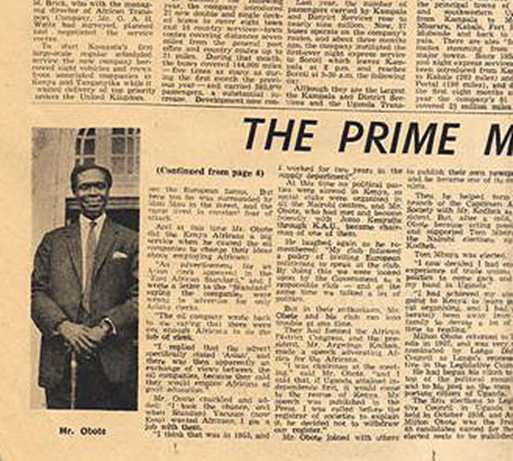 At this time no political parties were allowed in Kenya, so social clubs were organised in all the Nairobi centres and Mr. Obote, who had met and become friendly with Jomo Kenyatta through K.A.U., became chairman of one of them. He laughed again as he remembered: “My club followed a policy of inviting European politicians to speak at the club. By doing this we were looked upon by the Government as a responsible club – and at the same time we talked a lot of politics.”
But in their enthusiasm, Mr. Obote and his club ran into trouble at one time. They had formed the African District Congress and the president, Mr. Argwings Kodhek, made a speech advocating Africa for the Africans. “I was chairman at the meeting” said Mr. Obote, “and I said that if Uganda attained independence first, it would come to the rescue of Kenya. My speech was published in the Press. I was called before the registrar of societies to explain it. He decided not to withdraw our register”.
Mr. Obote joined with others to publish their own newspaper and he became one of its columnists.
Then he helped form the branch of the Capricorn Africa Society with Mr. Kodhek as president. But, after a split, Mr. Obote became acting president and supported Tom Mboya in the Nairobi elections against Kodhek. Tom Mboya was elected. “I now decided I had enough experience of trade unions and politics to come back and try my hand in Uganda. I had achieved my aim of going to Kenya to learn political organising and I had deliberately been away from my family to devote a lot of my time to reading.”
Milton Obote returned to Uganda in 1957 and was very soon nominated by Lango District Council as Lango’s representative in the Legislative Council. He had begun his climb to the top of the political mountain and to his post as the most important citizen of Uganda.
The first elections to Legislative Council in Uganda were held in October 1958 and Apolo Milton Obote was the first of 45 candidates named for the 10 elected seats to be published in a list in the “Uganda Argus”. Standing as a candidate of the Uganda National Congress, led by Mr. Joseph Kiwanuka, Mr. Obote took a hand as his symbol to vie with three other candidates for the Lango seat. In his manifest he said he was standing as a U.N.C. candidate “on its dynamic self-government now.”
And he came out then with a policy that he still advocates now – “waging war against ignorance and disease”, although he added then “and against inefficient producers of wealth”. The U.N.C. won five of the ten seats and Milton Obote, in the only district where all four main parties had a candidate, polled 40,081 votes to the next candidate’s 7,863 – the second highest majority in the country and the highest percentage of the votes.
Pelted with eggs
Officers of the party at that time were: Chairman, Mr. Joseph Kiwankuka, president, Mr. I.K. Musazi and deputy president, Mr. Milton Obote.
But first came a split between Mr. Musazi and Mr. Kiwankuka, when Mr. Musazi accused Mr. Kiwanuka of being a Communist. Young members of the U.N.C. went along to a meeting held by Mr. Musazi at the Tree of Liberty near Kampala bus park, pelted him with eggs and when his loudspeaker broke down, took over the meeting with their own loudspeaker.
Milton Obote became the new president, but then split with Mr. Kiwanuka over funds given to Mr. Kiwanuka by China for the U.N.C.
Together with Mr. George Magezi, Mr. William Nadiope and other Legislative Councillors, Mr. Obote formed a new party – the Uganda People’s Congress, with himself as the first and so it has transpired, only president general.
Well in front
A boycott by Buganda of the general elections of 1960 gave the D.P. victory – but the Leader of the Opposition was a young and promising politician named Milton Obote.
And the general election of April this year, with no boycotts left the U.P.C. well in front.
Now Mr. Obote sees his party firmly wedded to Kabaka Yekka and says they have at least five years to work together in putting independent Uganda well on the road to prosperity.
“I see the U.P.C. becoming a very powerful political organisation outside Buganda. I would not like to encourage the U.P.C. to do the same thing in Buganda, and I would like to see the U.P.C. and the K.Y. come together as did the Tories and the Unionists in the United Kingdom”.
Mechanisation
Mr. Obote sees the need for a responsible opposition to the Government and recalled: “Some of my happiest days in politics have been spent in Opposition.”
I asked him what he thought of the economic future of Uganda.
“The key to the economic future is that we should maintain a stable country”, he replied. “That is fundamental. After that we need to workout schemes that we can sell to private enterprise. I am determined that the country shall remain stable and people can confidently invest their money in Uganda. I would like to see Uganda farmers changing from the hoe to better implements and using more mechanisation. I have been talking to the Minister of Agriculture and Co-operatives (Mr. M.M. Ngobi) on modern agricultural implements being provided for the next cotton season.”
Eat more meat
“I want farmers to be encouraged to use this equipment on payment of a small fee or on short credit terms – where they pay for the service when they sell the crops – and the Minister is now working on this. He is also working on a scheme to improve the production of food crops. I also want to see a revolution in animal industry, which I think has a great potential. I want people to drink more milk and eat more meat and the Minister of Animal Industry (Mr. John Babiiha) is working on a scheme to attract foreign capital”.
When we discussed the position of non-Africans in independent Uganda, Mr. Obote told me: “I am not colour minded. I don’t care about colour and I am pretty certain the K.Y. has the same beliefs as ourselves.”
Read MoreHow to Choose the Right Car to Rent in Uganda
Reaching the airport on time and navigating through the busy peak time traffic can be a challenging task. Plus, the point-to-point taxi service providers often cancel the booking at the last minute and make it more difficult for you to reach a destination on time. This is where the car rentals come in.
You can book a car from car rental companies to save time and effort. Plus, professional drivers who know the main and the alternative routes to reach a place well. Therefore, with these services, you can never be late or miss a flight. However, you should choose a car rental service carefully keeping the following aspects in mind.
Companies providing Uganda car rentals offer a wide variety of services and car options. Before hiring a car service, check the following factors without fail.
Number of people in the journey
Before booking a car from a car rental company, check the number of people for whom you would need the car. If you are a family of 4 to 5 members or more, search with the keyword car rental near me to book a spacious car like a Landcruiser V8, 5-seater Landcruiser LX, a van or Extended safari Landcruiser. On the other hand, for couples, a comfortable sedan is adequate.
Therefore, your choice of car should be based on the number of people travelling and the variety of transportation experiences you are expecting.
Type of the trip
The next factor that you should consider before hiring a car should be the agenda of the journey. Some people travel for business purposes while some travel to enjoy a vacation. You can also hire a car on rent with driver for daily commutations to the office, market, or any other places in your city. For the camping trip, you can consider renting a car that is fully equipped with camping gear which usually includes a fridge running on a separate battery. If you are going into savannah national parks, you can consider renting a car with a pop-up roof.
Think about the terrain
The terrain can influence your choice. For city streets, a compact car is great. For mountainous areas or off-road adventures, consider a 4×4 is required. Match the vehicle to the environment to avoid getting stranded during your trip because of choosing a wrong car option. Most of the car rental companies will recommend the suitable car option when you share your travel plan with them.
Consider mileage and budget
Both budget and mileage are critical for choosing car rentals. All cars are not ideal for all types of journeys. For example, if you are planning to travel long distances, you need a car that offers comfort and unlimited mileage for the trip to avoid any unnecessary additional charges.
The vehicles like the Landcruiser LX, Landcruiser GX and Landcruiser V8 remain the best alternatives for such tedious journeys. These cars offer four-wheel drive perfect for any road condition and generally give a higher mileage during your travel. For short distances and intra-city travel requirements, Toyota Rav 4s and Prados are perfect especially if you are traveling alone.
Along with mileage, you should also consider your budget. The reputable car rental booking companies keep cars that are comfortable, give decent mileage, and have all modern features. Therefore, based on your budget, you can choose from the Landcruiser’s.
Consider fuel efficiency
Fuel costs grow quickly, especially on long trips. So, choosing a car with good fuel efficiency is a good decision to save you money. Smaller cars usually consume less fuel. The newer car options will save you more fuel compared to the older car options.
Check the luggage space
Make sure the vehicle has enough space for your luggage especially if you are going on a long camping trip. If you travel with many bags or sports/hiking equipment, a Landcruiser might be necessary. Don’t underestimate the importance of a spacious boot.
Inspect the car before you leave
Before driving off, inspect the vehicle thoroughly. Look for any existing damage and ensure it’s documented. Check the fuel level and make sure all features work. It can prevent disputes when you return the car. This will save you a lot of time especially incase the car is picked up by a person that was not aware of these scratches or damages.
In conclusion
Choosing the right rental car is pretty simple, as you see. Just follow these tips to find the perfect vehicle for your needs and enjoy a hassle-free trip.
Read MoreTraditional Marriages: Ankole Style
..among the Bahima (section of the Banyankole) girls who were about the age of marriage were forced to feed on milk until they were very heavy. “They could barely walk,” an Ankole elder once joked during an introduction ceremony.
One of the few remaining spectacular cultural things to talk about the Banyankole of South-Western Uganda is their culture-rich marriage ceremony of the once very prestigious lake kingdoms of the present day Great Lakes Region.
Because of influence from other cultures and lack of a cultural institution to ensure continuity of the culture following the abolishment of the Ankole monarchy in 1966 by the then Uganda Prime Minister Apollo Milton Obote, other cultures died out.
The traditional marriage has despite this influence survived the test of time. Although a few things could have changed because of religion and modernity, many Banyankole still embrace their traditional marriages because the elders still emphasize and control cultural marriage.
Indeed, many people intending to marry usually go for consultations from elders. So, what are the key spectacular elements of the Ankole marriage?
Marriage Arrangements:
The common thread in the Ankole marriage like many African traditional marriages is to create closeness to the bridal family. This is done through a third party called the Kateraruume (literally meaning somebody who will remove the dew from the path).
Even today when couples go for the official introduction and marriage after they have been co-habiting, this go between is key in initiating the marriage negotiations.
The Kateraruume is a highly respected person representing the groom’s interests and is charged with facing the bride’s family and ensuring that the bride’s family is willing to accept the groom’s family to formally discuss the marriage.
In case the proposal is endorsed, the man’s family approaches the girl’s family with the Kateraruume leading them there. At the home of the bride’s family, the go-between knocks at the gate and is invited in with the groom entourage after some teasing. The entourage usually comes with beer.
The Kateraruume then indicates to the girl’s marriage panel that he is on a marriage mission. The go-between then explains his mission and is asked many questions by the girl’s family. Later, they discuss the marriage payments, which can be picked anytime after the two families have agreed, sometimes on that same day.
This is followed by preparations for marriage. In Ankole tradition, the marriage payment included cattle, which may go to over 10. These gifts are presented to the bride’s family symbolizing the ability of the groom to take care of his woman.
The bride and groom to be:
During this ceremony, the bride and the groom are not party to the discussions. The bride is usually hidden while the groom has to keep quiet throughout the discussions and wait for the outcome. In this case however, the groom-to-be is ‘king’ because everything is done on his behalf.
In traditional Ankole society, a man marries a woman. A woman never marries a man. It is taboo if a woman seeks out a man’s hand in marriage. Also, it is the man who chooses not the woman. Therefore the woman has to be ‘marry-able’.
Unlike today where men treasure small sized women for marriage (I hope you have heard of words like portables and songs like obukazi obutono bulimu ekyama– “those small women last longer” or literally “those small women have years in them”), in the Ankole tradition, slim girls were unfit for marriage.
That is why among the Bahima (section of the Banyankole) girls who were about the age of marriage were forced to feed on milk until they were very heavy. “They could barely walk,” an Ankole elder once joked during an introduction ceremony.
The Give Away (Okuhingira)
Unlike today where the men feel cheated by paying bride price, in the typical Ankole tradition, a groom gains from the marriage.
Actually, the gifts (the emihingiro) that the bride comes with sometimes are more than those paid by the groom as bride price. For example, among the Bahima-Banyankole, the aunties and uncles give cows to the bride during the kuhingira.
Younger girls and boys called the enshagarizi then escort the bride to the groom’s place after the blessings from the elders. Today, the groom’s side has to organise the transport for these people because they are very important for any marriage ceremony in Ankole. Going back is not necessarily the role of the bridegroom.
After the kuhingira, the bride’s side is still is control though. The bride according to the culture is not supposed to do any work until the cultural initiation. This is done after about ten days from the giveaway day.
During this initiation, the bride is made to light fire in the kitchen in the tradition called okukoza omumuriro (helping the bride to start toughing fire).
Because of modernity however, some brides have left the bridal room (orusika) the day after marriage to continue looking for a living in the competitive world where every minute lost contributes a lot to poverty in the homes.
So, many people in Uganda may find it hard to understand the Ankole culture and language but many know the words okwanjura, okushwera and okuhingira irrespective of the language they speak.
Exciting Hike through Thick Bwindi Forest
The Bwindi Impenetrable Forest National Park is one of the toughest hikes I have ever faced – from walking the trails of Kibale and Mabira forests to conquering the first part of the Rwenzori Mountains.
The thick forest blankets tens of hills covered partly in mist and fog and there is nothing you can see beyond a certain point.
The forest is located in Uganda’s south western region near the DRC and Rwanda borders, and is one of the homes of the rare mountain gorillas. The other place where you can find gorillas is the neighbouring Mgahinga Forest.
Bwindi is famous for gorilla tracking, the country’s biggest revenue earner. There is now an option to take a nature walk through the forest, not purposely to see the gorillas, at a cost of Ush30,000 ($8). The cost of a permit to go gorilla tracking is $600.
I joined a group of Ugandan media colleagues, under our umbrella network Conservation Media Camp, on a trip to Bwindi.
We were attending the launch of the area’s first Batwa Cultural Centre built by local NGO Change a Life Bwindi.
The Batwa are forest people and one of the oldest surviving tribes in Africa, but their culture, identity and language are under increasing threat.
The areas where the Batwa lived and hunted were mainly forested areas between Uganda, Rwanda, Burundi and the Democratic Republic of Congo.
The land was taken over in 1991 for conservation projects to protect mountain gorillas. The Batwa now live in small communities near the forests.
The trek
The host for our trip, the Ihamba residence, is located on top of a hill that overlooks the forest in the east, from where one can see the vast Queen Elizabeth National Park and Lake George.
The hill has tea plantations on its slopes, as this is the only crop that can grow here without primates from the park destroying it.
About 15 of us inexperienced hikers decided to take on the forest nature walk, which involved going up and down forested hills with thick undergrowth.
We went in single file through the tea plantations. After a briefing of the ground rules, which included carrying at least two litres of water each, keeping our voices low so as not to scare away animals and not to litter, we set off, breaking the silence rule as we occasionally broke into song and cracked jokes that threw the entire group into laughter.
Ahead of the line was a machete-wielding colleague who had some geographical knowledge of the forest.
Using the machete, Michael Otti cleared a trail by cutting away small branches and clearing undergrowth.
Behind us was a gun-wielding Uganda Wildlife Authority ranger whose job was to scare away dangerous animals and to keep us out of trouble in case we came across poachers.
The forest has duikers, elephants, several snake species, baboons, monkeys and other animals that we were eager to encounter.
The hike usually takes six hours, but we took eight.
The trek starts with downhill the from Ihamba residence to the base of the forest. The hill was so steep that several colleagues abandoned their walking sticks and slid down on their buttocks.
We walked through thickets, jumping over fallen logs and across small wooden bridges on streams running through the forest with thunderous noises of their water falls.
We spotted rare birds, butterflies and other insects.
“You all need to keep quiet so we can listen ‘to the sights and sounds’ of the forest,” Tina Katushabe, one of our group, said.
The air was fresh, and we could hear a distant waterfall that was our final stop. Birds chirped in the swaying trees that were taller than any I had ever seen.
We continued like this for a few more hours, exhausted and hungry because we had underestimated the hike – we took a few rests until we realised that it was about to rain.
Since we didn’t want to be drenched, we diverted to an alternative route out of the forest that set us two hills away from our starting point. The forest walk was done, but we still had two more hills climb to get to our place of abode.
Despite all the obstacles and our exhaustion, the whole experience is something I would recommend.
Read MoreUganda Settlement Patterns, a mix of Rural Life and Growing Cities
Uganda’s diverse historical and contemporary influences have shaped its settlement patterns, creating a vibrant and multi-faceted society. The blend of rural traditions with urban growth, along with the rich diversity of ethnic groups and cultures, makes Uganda an exciting destination for travelers.
Often referred to as the “Pearl of Africa,” the country boasts a primarily rural population. However, the country’s urban areas are rapidly growing, with about one-sixth of the population now living in cities. These urban centers, especially Kampala, the capital, and the surrounding districts of Wakiso, Mukono, and Mpigi, are becoming increasingly important hubs for commerce, education, and culture. This growth reflects the dynamic shifts in the settlement patterns of the country.
Today, let’s dive into the settlement patterns of Uganda and their significance to the country’s growth.
The growth of Cities
Kampala, Uganda’s capital, stands as the largest city and is a focal point for both economic and social activity. In recent years, urban centers in the southern part of the country, including Jinja, Mbale, Masaka, and Entebbe, have also grown in significance. Gulu, in the northern region, serves as an important urban center as well.
The rapid growth of these towns can be attributed to rural-urban migration within the southern regions and people moving from the north in search of better opportunities in the cities. These shifting settlement patterns demonstrate a country in transition, with rural populations increasingly seeking opportunities in urban hubs.
Agriculture and Livelihoods
In Uganda, traditional farming practices and livestock keeping are key to the livelihood of many communities. In the northern part of the country, some societies combine cattle keeping with cultivation, while in the southern parts, sedentary agriculture or subsistence farming is more common.
Farmers in southern Uganda typically keep livestock such as goats, chickens, and ducks, with more prosperous farmers owning local breed cattle or even imported breeds. Well-spaced homesteads surrounded by farmland are a common feature in central, eastern, and southern Uganda.
These farming practices remain the cornerstone of the region’s economy, providing sustenance and livelihoods for the majority of the population.
Historical Influence Urban Development
Historically, Uganda’s urban development was shaped by colonial policies. During the colonial era, the British settlers were not encouraged to settle widely in Uganda, unlike in Kenya, where they established large agricultural estates. Instead, the British and other Asian immigrants primarily resided in Uganda’s towns, forming a minority in urban areas.
Over time, as businesses grew and the economy developed, a thriving class of Black urbanites emerged. This class contributed to the vibrant growth of Uganda’s cities, with an increasing number of Ugandans moving to urban areas in search of work and better opportunities. The post-colonial period witnessed the rise of a more inclusive urban culture.
The Indigenous People of Uganda
One of the most unique aspects of Uganda’s settlement patterns is the presence of the Batwa pygmies, who occupy parts of the western and southwestern regions of the country.
The Batwa are considered the original inhabitants of Uganda, with a history that dates back centuries. They live alongside Bantu-speaking people, adopting the languages of their neighbors, such as Rukiga and Kinyarwanda.
The Batwa’s population is concentrated around the Bwindi Impenetrable and Mgahinga Gorilla National Park, known for their rich biodiversity and stunning landscapes. Despite their historical marginalization, the Batwa remain an integral part of Uganda’s cultural and social fabric.
Read More
The Abduction of Dr. James Makumbi
On this day, the 5th of April, in the year 1995, the nation of Uganda stood in collective shock and relief as Dr. James Makumbi, the then Minister of Health, emerged from the grips of a five-day abduction by the Federal Democratic Alliance Forces, a rebel faction led by the enigmatic soldier, Maj. Hebert Itongwa Kikomeko Ssedyabane. The events that unfolded during those dark days in April left an indelible mark on the nation’s history, unraveling a tale of terror, resilience, and political intrigue.
Dr. Makumbi’s abduction sent shockwaves through the corridors of power and echoed across the country, as citizens grappled with the brazen audacity of rebels targeting a high-ranking government official. Alongside him were his colleagues, Dr. Margret Nakafero Mugerwa, and Steven Kayiwa, then a student at Makerere University.
Their abduction, orchestrated by Maj. Itongwa and his cohorts, unfolded on the dusty roads of Magere, along Gayaza road in Wakiso District, a chilling reminder of the precariousness of life amidst the turmoil of rebellion.
As Dr. Makumbi faced his captors, Maj. Itongwa delivered a stark message, a blend of defiance and desperation. He implored Dr. Makumbi to convey to President Museveni the grievances that fueled their insurgency. It was a plea born out of frustration, a cry for attention to the plight of the federal leadership and the dismal working conditions endured by army officers.
In the midst of chaos, Maj. Itongwa sought to amplify their voices through the medium of Dr. Makumbi, leveraging his position to relay their demands to the highest echelons of power.
The aftermath of Dr. Makumbi’s release saw the wheels of justice set in motion, as the courts embarked on the arduous task of prosecuting the seven men implicated in collaborating with Maj. Itongwa and accused of treasonous crimes. It was a trial that captivated the nation, a testament to the resilience of the rule of law in the face of insurgency and rebellion
Yet, amidst the courtroom drama and political maneuvering, the scars of those five days lingered, etched into the memory of Dr. Makumbi and the nation at large. His ordeal served as a stark reminder of the fragility of peace and the ever-present threat of conflict lurking on the fringes of society.
As we reflect on this pivotal moment in Uganda’s history, let us not forget the bravery of Dr. William Makumbi, who emerged from the shadows of abduction with fortitude and resolve. Let us heed the lessons of the past, striving for a future where the echoes of rebellion are but a distant memory, and peace reigns supreme across our land.
Read MoreWhy is Uganda Called the Pearl of Africa?
Imagine stepping into a land where the sun kisses the earth just right, and the world is filled with the sweet aroma of ripe fruits. Welcome to Uganda, the “Pearl of Africa,” where nature’s beauty is a feast for the senses. The land is so fertile that if you plant a stick, it might sprout leaves by the next day!
Uganda, a paradise for those who love fruit, boasts an array of unique tropical delights. Imagine relishing one of the fifty-plus varieties of bananas, each with its distinct taste and texture, or indulging in a succulent pineapple so sweet that it might redefine your pineapple experience. And don’t forget the luscious papayas, brimming with flavor, turning every bite into a tropical trance.
But the Uganda safari adventure doesn’t stop there. Uganda’s fruit markets are a vibrant tapestry of colors and flavors. You can explore exotic fruits like jackfruit, whose sweet, fragrant flesh is a local favorite.
Here are some of the reasons why Uganda is the pearl of Africa
Mountain gorillas
The endangered mountain gorillas can only be found in three countries in the world and that is, Democratic republic of Congo, Rwanda and Uganda. Half of the world’s mountain gorillas can be found in Uganda making it the top tourist’s destination for this endangered species.
Birds
Uganda has got the highest concentration of birds in Africa boasting with over 1040 species of birds, in Uganda you will find migratory birds from north Africa and Europe. Queen Elizabeth is the number one birding destination with over 600 species of birds found. All national parks offer birding opportunities while you also see the world’s biggest bird in Kidepo valley national park.
The magnificent Rwenzori ranges sometimes known as the mountains of the moon will live you in awe of beauty as you behold different ecological habitats from savannah grasslands, rainforests, heath, alpine and permanent ice and snow. Some of its striking peaks are covered with glaciers, it’s the third high mountain in Africa and the most difficult to climb.
The devil’s cauldron
These mighty falls can be found in Murchison falls national park offering dramatic views of the ancient Nile which is the world’s longest river squeezing through a narrow space of seven meters wide wondrously forming a waterfall of 45 meters then flowing in a placid stream to lake albert. The park itself is home to over 450 bird species and home to various mammal species. The Victoria Nile starts from the eastern part of the country in the world’s second fresh water lake and largest tropical lake.
Culture
The Ugandan people are very rich in culture, many tribes have preserved their cultures from the ancient times. The Kasubi royal tombs which is a burial place for Buganda kings recognized this place as a world cultural heritage site and it’s one of the most typically African built building with vegan materials in the sub-Saharan. There are many cultural sites all over the country and a lot to learn from the people including the nomadic Karamojong’s. Tourists can get a taste of all cultures within the city at the Ndere cultural center. Uganda has over 45 ethnic groups.
Wildlife
Uganda is very rich in wildlife ranging from the tree climbing lions that can also be found in lake Manyara in Tanzania, other animals in Uganda are; lions, cheetahs, leopards, elephants, buffaloes, rhinos, bush bucks, water bucks, reed bucks, bush duikers, hyenas, Genet’s, hippocampus, bush bucks and many more. In Uganda, you can be sure of seeing the Big five of Africa.
Game drives and boat cruises through these parks reveal the raw beauty and drama of the African wilderness. Witnessing a pride of lions on the hunt, observing a herd of elephants bathing in a watering hole, or spotting a leopard camouflaged in a tree are just a few of the unforgettable encounters that await visitors.
Savannah Plains
Uganda’s vast savannah plains, dotted with acacia trees and teeming with wildlife, are a quintessential African landscape. These grasslands are home to iconic animals like lions, elephants, giraffes, zebras, and countless antelope species. National parks like Queen Elizabeth, Lake Mburo, Pian Upe, Kidepo Valley, and Murchison Falls offer exceptional Uganda safaris for game drives and wildlife encounters.
Rain Forests
Uganda’s rainforests, including the Bwindi Impenetrable National Park, Mgahinga Gorilla National Park, Semuliki National Park, and Kibale National Park, are biodiversity hotspots, home to a staggering array of flora and fauna. These lush forests are most famous for their populations of endangered mountain gorillas and chimpanzees, offering visitors a chance to observe Africa’s incredible primates in their natural habitat.
Ugandan people
The people of Uganda are incredibly warm and welcoming. Ugandans have embraced tourism and love to show visitors their beautiful country and share their culture.
The population of Uganda is around 45 million and is extremely diverse. Most people speak a Central Sudanic, Nilotic or Bantu language. Helpfully for visitors, many in the tourism industry speak English as well.
About 80% of the population lives in rural areas. Traditions and distinct cultures thrive here. Kampala, the largest city, has around one and a half million inhabitants. In the cities, many people live a very western-style life.
World-class safaris
Uganda is a fantastic destination for all of the six kinds of African safaris. The country has the Big Five, lots of other big game like giraffes, crocs, elands, cheetahs and hippos, endangered mountain gorillas, and many other Old World and unusual primates like colobuses, patas monkeys and chimpanzees.
Did you know Uganda is home to the mighty Murchison Falls and half of the world’s remaining mountain gorillas? Explore these and other amazing facts about the Pearl of Africa in this comprehensive guide for travelers.
Join us on a journey to uncover the secrets of this extraordinary land, and discover why Uganda truly deserves its sparkling reputation as the Pearl of Africa.
Mountains of the Moon
The Rwenzori Mountains, often referred to as the “Mountains of the Moon” due to their perpetually snow-capped peaks, are one of Uganda’s most iconic landmarks. This UNESCO World Heritage Site is home to Africa’s third-highest peak, Margherita Peak. It offers breathtaking views of glaciers, alpine meadows, and unique vegetation. The mountains are also a haven for hikers and climbers drawn to the challenge and beauty of this unique alpine environment.
Source of the Nile
In Uganda, you find the source of the mighty Nile, the longest river in the world. The Nile’s journey begins at Jinja, where it flows out of Lake Victoria and embarks on a 6,650-kilometer voyage to the Mediterranean Sea. Visitors to Jinja can witness the dramatic spectacle of the Nile’s birth, take boat trips to the source, and even try their hand at white-water rafting on the river’s exhilarating rapids.
In Conclusion
Uganda is a country of beautiful scenery and offers diverse activities like gorilla trekking, city tours, cultural visits safaris, multiday mountain treks, white-water rafting and so much more
Read More