Obote and Uganda’s Independence
” At the turning-point in the history of Uganda, I hope that all our friends will join with me in bestowing upon the new, independent Uganda our prayers and hopes for peace, prosperity and a growing strength in her now role in international affairs. Uganda has many friends, both within her borders and outside. With the goodwill of all who wish to see her prosper, Uganda will go forward from strength to strength.
Let us pause for a moment and look back along the path we have traveled. In the days before this part of the African continent was known to the western world, we became known as a group of peoples who welcomed the traveler, the missionary and the explorer. As the years passed, we reaped the benefit of this friendly nature of ours. The technical progress of the last half-century has transformed our country in countless ways. But, fortunately, we have continued to keep our own customs and culture. It is up to us now, more than ever, in shaping our new country, to achieve a consolidation, in which neither the rapid progress of recent years, nor the age-old customs of our forefathers, are lost or diminished, but rather fused into a new national characteristic in which the best is preserved, while the worst may be thrown away.
AN UHURU MESSAGE FROM THE PREMIER
from the Uganda Argus
National unity
What other aims have we, today, on looking forward? One of our first needs must be national unity. The narrow ambitions of a tribe, a sect, or a party must be subordinated to the greater needs of one complete Uganda.
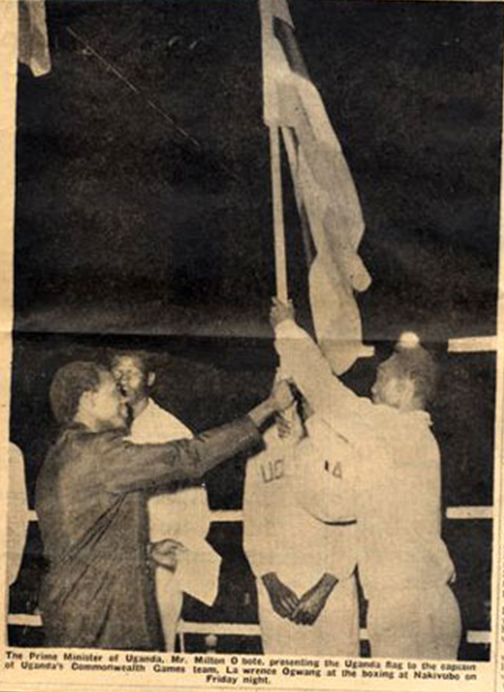 In our Government of these past months, we have striven to put the interests of Uganda before all else, and we shall continue to do so. But on attaining independence, this Government has new responsibilities to bear, heavier than those which any previous government in Uganda has borne, and we are conscious of the care and statesmanship with which we must move in taking our first steps in foreign affairs. In the Commonwealth and in the United Nations we shall be among friendly states, both from other parts of Africa and from elsewhere. But the regard in which a nation is held in the eyes of the world depends upon the successful operation of a complex machinery.
On 9th October, 1962, Uganda becomes an independent sovereign state within the Commonwealth of Nations. H.M. the Queen becomes Queen of Uganda and the Head of State, represented in Uganda by a Governor-General.
Her Majesty is to be represented at the celebrations by H.R.H. the Duke of Kent and the Duchess of Kent who will afterwards make a tour of the Regions.
from the Uganda Independence Souvenir Programme.
We have paid attention to the design of that machinery. First, we require political stability. My Government will seek to maintain that stability, by the strict maintenance of law and order, by retaining the confidence of the voters, and by upholding the freedom of the individual. Secondly, we require to safeguard the economy. This we will do by diversifying and improving our agriculture, providing incentives to industry, and creating conditions which encourage foreign investment. Thirdly, we will press forward with social services within realistic bounds and not as dictated by idealism. Fourthly, we need an efficient civil service to operate the Government. Uganda is well provided with well-qualified African officers and we shall continue to ensure that these are attracted into government service by the offer of the right terms, so that a balanced Africanisation programme shall continue.
I conclude by emphasising that there is a place in the Uganda of today for all who have her interests at heart, whatever their tribe, race or creed. Let all of us, who wish to see Uganda prosper, join together today in resolving to build a great and united nation.”
Read More
Exciting Hike through Thick Bwindi Forest
The Bwindi Impenetrable Forest National Park is one of the toughest hikes I have ever faced – from walking the trails of Kibale and Mabira forests to conquering the first part of the Rwenzori Mountains.
The thick forest blankets tens of hills covered partly in mist and fog and there is nothing you can see beyond a certain point.
The forest is located in Uganda’s south western region near the DRC and Rwanda borders, and is one of the homes of the rare mountain gorillas. The other place where you can find gorillas is the neighbouring Mgahinga Forest.
Bwindi is famous for gorilla tracking, the country’s biggest revenue earner. There is now an option to take a nature walk through the forest, not purposely to see the gorillas, at a cost of Ush30,000 ($8). The cost of a permit to go gorilla tracking is $600.
I joined a group of Ugandan media colleagues, under our umbrella network Conservation Media Camp, on a trip to Bwindi.
We were attending the launch of the area’s first Batwa Cultural Centre built by local NGO Change a Life Bwindi.
The Batwa are forest people and one of the oldest surviving tribes in Africa, but their culture, identity and language are under increasing threat.
The areas where the Batwa lived and hunted were mainly forested areas between Uganda, Rwanda, Burundi and the Democratic Republic of Congo.
The land was taken over in 1991 for conservation projects to protect mountain gorillas. The Batwa now live in small communities near the forests.
The trek
The host for our trip, the Ihamba residence, is located on top of a hill that overlooks the forest in the east, from where one can see the vast Queen Elizabeth National Park and Lake George.
The hill has tea plantations on its slopes, as this is the only crop that can grow here without primates from the park destroying it.
About 15 of us inexperienced hikers decided to take on the forest nature walk, which involved going up and down forested hills with thick undergrowth.
We went in single file through the tea plantations. After a briefing of the ground rules, which included carrying at least two litres of water each, keeping our voices low so as not to scare away animals and not to litter, we set off, breaking the silence rule as we occasionally broke into song and cracked jokes that threw the entire group into laughter.
Ahead of the line was a machete-wielding colleague who had some geographical knowledge of the forest.
Using the machete, Michael Otti cleared a trail by cutting away small branches and clearing undergrowth.
Behind us was a gun-wielding Uganda Wildlife Authority ranger whose job was to scare away dangerous animals and to keep us out of trouble in case we came across poachers.
The forest has duikers, elephants, several snake species, baboons, monkeys and other animals that we were eager to encounter.
The hike usually takes six hours, but we took eight.
The trek starts with downhill the from Ihamba residence to the base of the forest. The hill was so steep that several colleagues abandoned their walking sticks and slid down on their buttocks.
We walked through thickets, jumping over fallen logs and across small wooden bridges on streams running through the forest with thunderous noises of their water falls.
We spotted rare birds, butterflies and other insects.
“You all need to keep quiet so we can listen ‘to the sights and sounds’ of the forest,” Tina Katushabe, one of our group, said.
The air was fresh, and we could hear a distant waterfall that was our final stop. Birds chirped in the swaying trees that were taller than any I had ever seen.
We continued like this for a few more hours, exhausted and hungry because we had underestimated the hike – we took a few rests until we realised that it was about to rain.
Since we didn’t want to be drenched, we diverted to an alternative route out of the forest that set us two hills away from our starting point. The forest walk was done, but we still had two more hills climb to get to our place of abode.
Despite all the obstacles and our exhaustion, the whole experience is something I would recommend.
Read MoreUganda Settlement Patterns, a mix of Rural Life and Growing Cities
Uganda’s diverse historical and contemporary influences have shaped its settlement patterns, creating a vibrant and multi-faceted society. The blend of rural traditions with urban growth, along with the rich diversity of ethnic groups and cultures, makes Uganda an exciting destination for travelers.
Often referred to as the “Pearl of Africa,” the country boasts a primarily rural population. However, the country’s urban areas are rapidly growing, with about one-sixth of the population now living in cities. These urban centers, especially Kampala, the capital, and the surrounding districts of Wakiso, Mukono, and Mpigi, are becoming increasingly important hubs for commerce, education, and culture. This growth reflects the dynamic shifts in the settlement patterns of the country.
Today, let’s dive into the settlement patterns of Uganda and their significance to the country’s growth.
The growth of Cities
Kampala, Uganda’s capital, stands as the largest city and is a focal point for both economic and social activity. In recent years, urban centers in the southern part of the country, including Jinja, Mbale, Masaka, and Entebbe, have also grown in significance. Gulu, in the northern region, serves as an important urban center as well.
The rapid growth of these towns can be attributed to rural-urban migration within the southern regions and people moving from the north in search of better opportunities in the cities. These shifting settlement patterns demonstrate a country in transition, with rural populations increasingly seeking opportunities in urban hubs.
Agriculture and Livelihoods
In Uganda, traditional farming practices and livestock keeping are key to the livelihood of many communities. In the northern part of the country, some societies combine cattle keeping with cultivation, while in the southern parts, sedentary agriculture or subsistence farming is more common.
Farmers in southern Uganda typically keep livestock such as goats, chickens, and ducks, with more prosperous farmers owning local breed cattle or even imported breeds. Well-spaced homesteads surrounded by farmland are a common feature in central, eastern, and southern Uganda.
These farming practices remain the cornerstone of the region’s economy, providing sustenance and livelihoods for the majority of the population.
Historical Influence Urban Development
Historically, Uganda’s urban development was shaped by colonial policies. During the colonial era, the British settlers were not encouraged to settle widely in Uganda, unlike in Kenya, where they established large agricultural estates. Instead, the British and other Asian immigrants primarily resided in Uganda’s towns, forming a minority in urban areas.
Over time, as businesses grew and the economy developed, a thriving class of Black urbanites emerged. This class contributed to the vibrant growth of Uganda’s cities, with an increasing number of Ugandans moving to urban areas in search of work and better opportunities. The post-colonial period witnessed the rise of a more inclusive urban culture.
The Indigenous People of Uganda
One of the most unique aspects of Uganda’s settlement patterns is the presence of the Batwa pygmies, who occupy parts of the western and southwestern regions of the country.
The Batwa are considered the original inhabitants of Uganda, with a history that dates back centuries. They live alongside Bantu-speaking people, adopting the languages of their neighbors, such as Rukiga and Kinyarwanda.
The Batwa’s population is concentrated around the Bwindi Impenetrable and Mgahinga Gorilla National Park, known for their rich biodiversity and stunning landscapes. Despite their historical marginalization, the Batwa remain an integral part of Uganda’s cultural and social fabric.
Read MoreThe Mountain Gorilla Highlands
Uganda’s Gorilla Highlands stretch from Kabale area, Kisoro, Bwindi Impenetrable Forest, Mgahinga National Park to Kanungu area conveying most of Uganda’s beautiful scenic views.
Uganda is a haven for many natural attractions like the lakes from where one can enjoy the wonderful sights and sounds of various bird species such as Lake Bunyonyi, Lake Kayumbu and Lake Chahafi, Lake Mutanda and Lake Mulehe. It’s also park for mountain gorillas found in Bwindi Impenetrable National Park. It’s also a home to many primate species like the chimpanzees, golden monkeys which can all be tracked with the help of a well-trained tour guide.
Recently-developed trails offer some of East Africa’s most spectacular hikes across rural Africa, safe to explore per pedes apostolorum, by dugout canoe across the lakes or by mountain bike cross country.
Only a few parts of Uganda have been documented with trail descriptions, maps, and video maps, the latest tool available for wannabe visitors to this part of Uganda. Accommodation is now available from basic camping over home stays to luxurious lodges.
According to Miha, the head behind the gorilla highland project “The Gorilla Highlands initiative” was started in 2011 by Edirisa, a social enterprise based at Lake Bunyonyi. It is open to anybody interested in branding and promoting southwestern Uganda for the sake of rural development. It has established the ‘Gorilla Highlands’ brand as a flag to unify the region, connect local companies of all sizes into a network, and expand tourist expectations of what the area can offer. We are focused on innovative solutions to tell the world an engaging story about our part of Africa. The Gorilla Highlands initiative offer travelers, tour operators, the media, and development organizations a centralized and consistent service built on extensive local knowledge.”
He further noted, “We are tapping into a world-class web of professionals passionate about this region whose very first product, the Gorilla Highlands Interactive eBook, won a United Nations award in 2013. While the eBook showcases our deep knowledge of our home area, Gorilla Highlands is much more than that. We are about rural development empowered by culture. Our belief is that economic transformation in southwestern Uganda is only possible when we have respect for our cultural heritage, and when we properly utilize tourism as a tool to uplift the poor.”
In his notes, Miha Logar stated that “Our current biggest project is the Gorilla Highlands Video Map. It challenges tourists’ potentially negative preconceptions by giving video tours of places, lodges, and activities, revealing beautiful, comfortable, and safe environments. On the other hand, we don’t just do multimedia products. We tell our story of southwestern Uganda through tourism experiences as well – Gorilla Highlands Trails is a system of guided trips, taking from 5 hours to a week or more, including camping with rural families and with a special stress on the Batwa.
“Our tour itineraries already utilize Kigali as the airport hub; expansion of the Gorilla Highlands concept into Rwanda is planned for 2015.”
By using Kigali as the entrance airport helps to lessen / cut short the distance covered to reach the south western part of Uganda. It is also suggested to use due to the existence of the common tourist visa that entails visitors easy passage through Uganda, Rwanda and Kenya and it can be obtained at 100 USD.
In addition, this gives tourists a chance to enjoy the beautiful sights of “Land of a Thousand Hills” before crossing over to Kisoro / Katuna and Kabale via Cyanika border for the amazing spotlights of the South Western part of Uganda.
Uganda is now connected to the rest of the world by the top African, European, and Gulf /*8airlines daily and apparently known among Africa’s number one adventurous destinations since it’s a peaceful and Ebola Free State.
Gorilla Highlands offers pocket guides and last year launched the award winning e-book available from the Apple Store.
Read More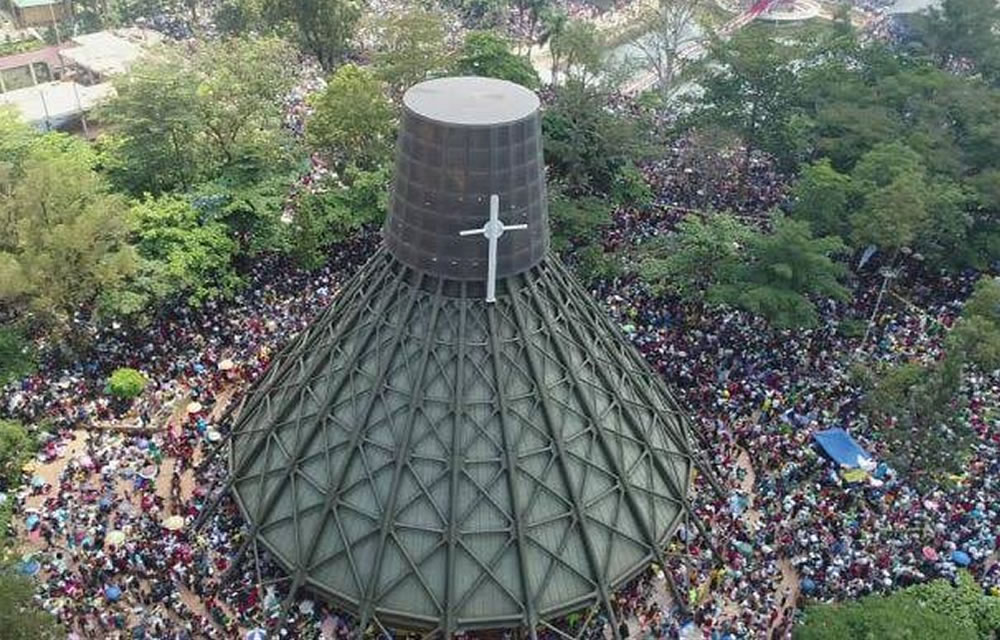
Celebrating the 3rd June Martyrs Day in Uganda
Uganda martyrs day is celebrated every 3rd June of every day and many people flock to the Uganda Martyrs’ Basilica Namugongo to remember these great people who died for religion over 100 years ago. In Uganda, this day is a public holiday and within the Roman Catholic Church, the 3rd journey is reserved for charles Lwanga and his companions who were burnt alive in this historical site. Travelers from all over the world, within Uganda and the far places flock to this sacred place to make their pilgrimage to this holy land. This is one of the biggest events in Africa attracting millions of people.
This year, a Uganda Martyrs’ Trail has been developed by tour operators and tourism organizations involving a walk from Munyonyo, one of the other places where the martyrs were killed. For those who come for safaris to Uganda, including a visit to the Namugongo Shrines is possible and in many tour itineraries involving a Kampala city tour, this sacred place is often included with an excursion to the site.
The 3rd June celebrations begin with a Novena in many parts of the country especially in places where the martyrs were either born or killed. The Novena begins in May to June when the celebrations are carried out. This novena at Namugongo is also attended by the pilgrims from the neighboring countries LIKE Kenya, Tanzania, Rwanda, Burundi Nigeria, Congo and also from other countries. This has helped in increasing the number of people who travel to Uganda in order to enjoy the safari tour to Namugongo. Many of the pilgrims , young and old , walk miles from their home areas yup to Namugongo as a sign of honor to the martyrs who shed their blood for the sake of our lord Jesus Christ,
Pilgrims also spend weeks on this long journey trying to invoke the Uganda Martyrs to intercede for them in overcoming their problems. These, indeed have often testified Martyrs’ positive reaction to their prayers as they get salvaged from their bonds. The preparation of Uganda Martyrs day not only encourage the faithful hearts to this place but also business people as well as come to the place , these include; those who sell food stuffs and other merchandise to Fellow business people and to the pilgrims. This however makes the number shoot high not only at Namugongo but even in the neighboring trading centers.
At the end of it all, the celebration of the high mass on 3rd June, the liturgy celebrations are organized by various dioceses, this is done year after year. Mass usually begins at 10 which is east African time. This is accompanied by the liturgical dances organized by the leading diocese. Many important persons from Uganda Government, embassies and many other countries have always attended the celebrations. The security of the place is always tight in order to keep law and order and also this makes the celebrations more peaceful despite the big numbers of people. The same people who come for the celebrations can also be attracted by many other attractions which are found in Uganda and these include; the mountain gorillas, mountain climbing, chimpanzee trekking, culture, city tours, and many more.
Read MoreUganda: Gorilla Tourism Spurs Growth in Kigezi Region
Mountain gorilla tourism has not only contributed huge sums of money to the national economy, it has immensely sparked development in the Kigezi sub-region.
More than 18,000 gorilla permits are sold annually, which translates into an annual collection of more Shs38b. Each permit costs Shs2.16m ($600). According to John Justice Tibesigwa, the Bwindi and Mgahinga National Park acting conservation area manager, mountain gorilla tourism started in 1961 when the area was still a sanctuary.
In 1991, it was strengthened and was later, in 1994, recognised as a heritage site.
Tourism, Tibesigwa says, has not only benefited government but enabled Uganda Wildlife Authority to contribute Shs900m annually to communities around Bwindi-Mgahinga for development projects.
The Bwindi-Mgahinga area has more than 14 gorilla groups and only eight tourists are allowed to visit a gorilla group per day.
Available data indicate that the Bwindi-Mgahinga area has half the world’s population of mountain gorilla.
This, as a result, has attracted tourists in the area and has had a spillover effect in terms of service development, especially in hotel and hospitality and the transport sector.
Source of employment
More than 100 hotels and camp sites have been established and provide employment to more than 10,000 people.
Hotels such as Accadia Cottages, Bunyonyi Overland Resort Camp, Entusi, Bushara and Sharp Island Gorilla Lodge, among others are a good addition to the Kigezi tourism.
In the transport sector, an airstrip has been established in Kihiihi, Kanungu District and another is under construction in Rubanda District. The two will be an addition to the already existing Kisoro Airfield.
“Tarmacking Kabale- Kisoro road has also facilitated development. However, government should improve internet connectivity, provide electricity, especially in the national parks,�? Ivan Mbabazi Batuma, a member of the Kigezi Tourism Cluster, says.
Other tourism features such as Lake Bunyonyi, Mt Muhavura, and Queen Elizabeth National Park, Batuma says, should be promoted to create alternatives as well as establishing a special desk at border points to handle tourists.
Nicholas Byengoma, the vice chairperson of the Kigezi Tourism Cluster, says whereas government has injected money into the tourism sector, more needs to be done.
“Encourage the establishment of domestic air transport to ease movement, especially for tourists visiting different destinations, he says.
Tourism, as already stated, employs more than 10,000 people in the Kigezi sub-region and this, according to Seith Byarugaba, an investor in accommodation, is a big achievement that government should leverage on.
“There is need to habituate other animal species such as chimpanzees, red monkey and birds to diversify, he says.
Government, Fideli Kanyamunyu, the director of Wagtail Tourism Investments in Kisoro District, believes should return much more to local communities instead of the current 20 per cent.
“… giving us only 20 per cent of the entrance fees, which is only $40 out of the $600 should be revised, he says and appeals to government to consider giving soft loans to community members to improve the quality of their products.
But beyond looking at government, Akankwasa Barirega, the acting commissioner for Wildlife Conservation at the Ministry of Tourism, advises local communities and members in the Kigezi Tourism Cluster to be more innovative, especially in regard to creating tourism amenities.
For instance, he says, people should think of establishing facilities such house boats on Lake Bunyonyi, zip lines crossing the interlocking hills, cable cars on Mt Muhavura and hot air balloons, among others.
“You earn a lot because there is a ready market [tourists], he says.
Silver Baguma, the vice chairperson of Rubanda District, thinks that stakeholders meetings such as the one held recently, provide good engagement.
However, he argues, for employment opportunities, residents must be considered as the first priority.
Read MoreBritish Airways Suspends Flights to Entebbe
British Airways confirmed its flight suspension from Heathrow to Entebbe, with the last flight to Entebbe on October 2, 2015 and out of Entebbe to Heathrow on October 3 due to commercial reasons said by Edward Frost the Regional Commercial Manager East & Southern Africa. Looking at the plans British Airways had for Uganda in the past six years especially the commitment to serve the travel market was a main factor to host more flights between Entebbe and Heathrow.
The Discovery of Oil in Uganda is one of them, the 2010 world cup in South Africa, and the 2012 Olympic Games in London. The airline flights increased from three to five a week due to the high demand. However after the World cup, the Uganda Oil production delays by years made British airways to weigh the Uganda market as not viable to sustain its operations making it cut its flights back to three.
Come 2014 the Airline grow prospects where high with plans of looking at East Africa as a region instead of a single destination. The airways announced to increase its flights from 3-4 times a week a plan which failed in some months later due to the increase of the ground handling rates by the Civil Aviation Authority something it had never done for a period of 20years. The authority believed that the older rates did not make business sense. Tariffs for a Boeing 737 (B737) aircraft, for example, initially used to be $1,100 per turnaround. However, the tariff was increased to $1,200. Depending on the category of the aircraft, tariffs can go up to $2,500 per turnaround. The increase made Entebbe airport lose some bit of its competitive edge, although the rates were still lower than those at the busier and bigger Jomo Kenyatta airport in neighboring Kenya.
Also the escalating volumes of trade between Uganda and countries in the Middle East have recently attracted several airlines offering services to countries like UAE, China and Turkey among others. There is now a record five Middle East based airlines operating in Uganda, including Fly Emirates, Fly Dubai, Turkish Airlines, Qatar Airways, Brussels airlines and Etihad Airways. Besides the best option airlines to London and USA.All customers who booked with British airways after 3 October 2015 will be given a full refund or can alternatively be re-booked, says Edward Frost, the airline’s commercial manager for East and Southern Africa though he wasn’t clear how many staff will be affected by the decision.
Read MoreKarimojong Warrior Dancers Wow Uganda Martyrs’ Pilgrims
This year’s annual martyrs celebrations on 3rd June were led by Bishop Giussepe Filippi of Kotido located North Eastern Uganda. He was accompanied by the diocesan choir and a troupe of Karimojong warriors donned in traditional garb in a gallantry of hymn, dance and worship to the delight of Pilgrims.
This year attendance hit the one million mark with President Yoweri Museveni being the chief Pilgrim. Also in attendance was Maria Nyerere widow of the founding Father of The Republic of Tanzania, Mwalimu Julius Kambarage Nyerere.
The President committed government support to the development of the martyrs’ shrines into tourism attractions. This will add impetus to efforts by the Uganda Tourism Board in promoting religious tourism that began with a martyr’s charity walk dubbed ‘in the Footsteps of The Uganda Martyrs the previous day.
Pilgrims came from as far as Malawi, Democratic Republic of Congo, Rwanda,Kenya, the United States of America and Nigeria.
Over 45 martyrs were burnt alive in 1886 on the orders of the reigning Kabaka (king) of Buganda following growing dissent in the kings court from the new converts to Christianity at the height of colonial struggle.
Festivities will be held in the same venue on the 18th October to commemorate Golden Jubilee since the canonization of the Catholic martyrs by Pope Paul VI.This shall coincide with the commemoration of the martyrdom of lesser known martyrs Jildo Irwa and Daudi Okello from Acholiland in Northern Uganda who were martyred almost 25 years later in Paimol.
Read MoreUganda Discounts Gorilla Permits
The management of Uganda Wildlife Authority (UWA) has launched a Gorilla tracking promotion to enable potential visitors enjoy the same gorilla experience at subsidized rates. According to a statement from the Executive Director, Dr. Andrew Seguya, the following promotional prices will apply for visitors wishing to track gorillas within the months April and May 2015.
Foreign Non Residents will pay US $ 350 for a permit instead of US$600, Foreign Residents US$300 instead of US $500 and East Africans will part with UGX150,000 instead of UGX250,000.
Dr. Seguya says in a statement that the promotion is aimed at giving back to UWA’s esteemed customers. The promotion which is open to all tour operators and partners will be guided by the following guidelines. The promotional period will run for the months of April and May 2015.
This applies to unsold permits for this period and does not include prepayments before announcement of this promotion.
Payment for all gorilla permits under the promotional rates shall only be done at the Reservations office at UWA Headquarters in Kampala only. No promotional permits will be sold at the park .Permits offered for sale under these promotional arrangements will be paid for in full (100% of value) at the time of booking. The acceptable payment methods are cash or direct bank transfers. There will be no cash refunds, reschedules, cancellations and transfers allowed on promotion permits. Promotional permits will be marked “”Promotional Permit””
Uganda is a home to more than half of the world’s population of mountain gorillas.Bwindi Impenetrable National Park and Mgahinga Gorilla National Park in South western Uganda are host to the mountain gorillas which live in organised social groups.
For further information and to reserver your permit please call reservations on +256 414355 403 or email reservations@ugandawildlife.org
Read More
Tooro Marks 18th Coronation Anniversary Tomorrow
Tooro Kingdom will September 7 (Saturday) mark its 18th coronation anniversary. King Oyo Nyimba Kabamba Iguru Rukidi ascended to the throne in 1995, following the death of his father, Patrick Olimi Kaboyo to become the 12th ruler of the 180-year-old kingdom.
The celebrations are scheduled to take place at the royal palace in Fort Portal, Kabarole District, will be graced by President Yoweri Museveni and other dignitaries from abroad.
The kingdom of Toro, of the babiito dynasty, aptly claims its rightful origins in the ancient empire of Kitara. The first son of Omukama Kyebambe III of Bunyoro rebelled and annexed the southern part of his father’s kingdom, forming his own kingdom.
He placed the northern border of his new kingdom at River Muziizi. The kingdom of Toro was born, under the reign of Rukirabasaija Omukama Kaboyo Kasunsunkwanzi Olimi I.
Following the death of Omukama Kaboyo Olimi I, there followed several other kings and princes on the Toro throne. Some of them reigned for very short periods of time, during which they were still referred to as “Omubiito” (prince) , not by the right title of “Rukirabasaija Omukama”. When we include such princes, the number of batooro kings comes to 8.
The present Omukama is Rukirabasaija Omukama Oyo Nyimba Kabamba Iguru Rukidi IV. A brief write up on each Omukama follows. It should be noted here that the numerical denotation of kings of Toro takes off from the list of Bunyoro kings, before Toro broke away. This is why, for instance, while there have been a total of two kings with the name Olimi on the Toro throne, Omukama Patrick Matthew Kaboyo Olimi was Olimi VII.
Read More