Uganda Tourism Revenues Rises to $800m
Uganda Tourism Board executive director Mr Cuthbert Baguma told a tourism symposium at the Museum recently that Uganda’s tourism earnings have doubled in the last five years from $440m (Shs1.1trillion) to $800m (around Shs2trillion) last year.
According to the report gorilla tracking contributed over 60per cent of that. Despite the mountain gorillas becoming the face of Uganda’s tourism and their recent population growth, these majestic creatures remain threatened thanks to man’s destruction of their habitat, poaching, armed conflict and disease. In 2010, a Bwindi gorilla was killed after an altercation with men who were illegally hunting in the park. The men were released after paying paltry fines ranging from $19 (Shs47,500) to $38 (around Shs95,000).
Now compare that to the fact that each mountain gorilla can generate up to $1m (Shs2.5b) per year in tourist revenue for the Ugandan economy and you will realise that wildlife crime laws are not strong enough to protect these animals.
The World Wildlife Fund (WWF) African Ape Programme Coordinator Mr David Greer said: “Through our partner the International Gorilla Conservation Programme, we are working closely with rangers and law enforcement investigators to ensure that when a wildlife crime does occur, evidence is handled properly so prosecutors can make a strong case in court.”
Gas Shortage Hits Kampala
A shortage of diesel has hit Kampala due to a delay of vessels that were bringing in the product through the Kenyan port of Mombasa.
The shortage has already seen some dealers increase the fuel prices although others have maintained the old prices.
Diesel has increased generally from sh3080 to as high as sh3200 at most filling stations.
A few stations have also taken advantage of the situation to increase petrol prices from sh3500 to sh3580 especially when their competitors run short of the products.
The increase has been noticed at several Shell, Kobil and Total filling stations in and around the city. However, some stations like Gapco Bwaise, Mo Petrol Kagoma and Total Keti Falawo along Bombo road were still selling petrol at between sh3450 and sh3500.
Diesel is the most used oil product in Uganda with over 1,585,000 litres used per day, according to the energy ministry data. But petrol which is consumed at 940,000 litres daily is now on higher demand.
A dealer who did not want to be named said there has been a delay in the supply of diesel in the last 10-14 days, forcing some dealers to increase prices out of speculation.
“There is a general shortage of diesel on the market. But it should not be a basis for increasing prices because the product is still on the market especially among big dealers,” the dealer noted. He, however, anticipated that the supply would normalize by Monday next week.
Rajni Tailor, the petroleum dealers’ national chairman said the shortage has been noticed not only in Uganda but also in Kenya. Tailor appealed to government to work on storage facilities arguing that; “Delays should not cause a shortage of fuel. Like I have said before, government should work on the reserves because when you have reserves you can run for a whole week even if vessels delay.”
Tailor also suggested that the MV Amani ferry that is operating along the Port-Bell Luzira-Mwanza route should also be used to bring in fuel through Tanzania.
“The ferry has a capacity of loading up to 40 wagons,” said Tailor. MV Amani with a seating capacity of 150 passengers is operated by Earthwise and plies the Port-Bell Mwanza and Port Bell-Kalangala routes.
In July this year, a shortage of petrol hit mostly Total filling stations in and around Kampala, resulting into panic buying by motorists causing the little available stocks to run out fast.
The shortage that was also caused by a delay in the vessel, resulted into hiking of petrol prices from sh3550 to as high as sh3900 with small dealers like Rio Oil, City Oil and Eagle, taking advantage of the situation
Read MoreOldest Fossil Ever Discovered on Earth Returned to Uganda
Remains of what is believed to be the oldest fossil ever discovered on Earth has been returned to Uganda. The fossil was discovered by a joint team of Ugandan and French scientists last year on July 18th 2012 at Napak, near mount Moroto, in Karamoja, North Eastern Uganda and is called Uganda pithecus Major.
This is the oldest, most complete ape fossil ever to be discovered on Earth and is believed to be aged between 19 and 20 million years. He has been returned after spending about a year in the French capital Paris where the skull fragments discovered were used to make a reconstruction of what the skull may have looked like.
Dr. Martin Pickford, a member of the team that discovered the fossil said that it could not be reconstructed here because it was so delicate and we lacked the necessary equipment to carry out the reconstruction.
He explained that the skull belonged to a tree climbing herbivore that must have died when it was about 10 years old, in its adolescence stage. The original fossil will be displayed as it was discovered, in pieces. Researchers in Paris scanned the fossil and using their knowledge of hominid development and a chimpanzee skull for comparison were able to digitally rebuild the skull.
true
Prof. Brigitte Senut of the Paris National Museum of Natural History who headed the project from the French side noted that multiple reconstructions were done in order to arrive at the most likely reconstruction of the skull.
Minister of Tourism, wildlife and Heritage Prof. Ephraim Kamuntu commended the scientists, calling their discovery a major one. “This fossil is very special. It’s like winning a gold medal at the London Olympics. We take pride in the fossil because it was found in our land. It is our contribution to the understanding of the origin of man.’’
The minister rubbished rumours that government intended to demolish the National Museum to give way for the construction of a mega building, saying the rumours were baseless.
“We can’t destroy our heritage like that. When you see the president giving sh2b for the reconstruction of the Kasubi tombs, it means we take our cultural heritage very seriously.’’
He said the fossil would be put in the museum so scholars and other people all over the world who were curious to know about the origins of mankind could come see it. Casts made of the fossils, will also be sent to competing paleontologists worldwide to increase the chances of getting an accurate reconstruction.
“If we attract more people to Uganda this means more revenue for the country.’’This year lonely planet, the largest travel guide book in the world, named Uganda the favorite tourist destination in the world.
He thanked the French government, which he said has been consistent in funding tourism related activities in Uganda. The minister revealed that in March this year the French people reconstructed a museum—the Karamajong Cultural Museum in Moroto—after the people of Karamoja expressed to the French Embassy in Uganda their need for a museum focused on their cultural heritage.
Prof. Senut said they returned the fossil back to Uganda because the fossil belongs to Uganda. It is part of Uganda’s heritage and the knowledge to be had from it represents yet another of Uganda’s contributions to the scientific community.
Read More
Visit Uganda : Discover her Beauty
They say beauty lies in the hands of the beholder but Uganda’s beauty appeals to everyone who encounter its attractions. Uganda is one of the African countries with unique natural attractions. Despite of being endowed with nature, Uganda is a tourism enhancing or encouraging country as its people are so welcome and the climates favors tourism activities to take place. Every day is a Sunny day in Uganda in other words the sun has to rise each and every day even if it rains heavily and who on earth does not want to relax in the sun or have a good time in the sun.
A visit to Uganda makes one discover natural beauties as it has very many natural attraction attractions. In Africa, Uganda is the king of eco tourism as it has natural environment to visit that is unhampered by man’s activities. One can feel the natural serenity when he/she takes a Uganda safari tour.
Uganda has over 1000 different species of exotic mammals like the lions, buffalos, hippos, elephants, leopard, rhinos, zebras, giraffes, oribis, elands, antelopes among the special ones. It has over 1060 species of bird, 50% of Africa’s birds and a third of the birds are endemic meaning they can only be found in Uganda like the shoebill, the crested crane among the special ones. One can never move around Uganda minus see a bird along the road, on the streets or up in the skies.
Uganda has very many primates and it is among the African countries with most primates due to the fact that it lies on the equator axis an area with equatorial vegetation which thrives the lives of the primates. These primates include the chimpanzees, red and white monkeys, golden monkeys, red tailed monkeys, grey cheeked mangabey to mention but a few. The mountain gorillas are also primates but they are worthy to be mentioned alone due to the fact that they are the most famous attractions in Uganda apparently. Many tourists come to Uganda to engage in gorilla trekking tours due to the lifetime experience they give to the gorilla trackers.
Uganda is also a home of the bird has it has over 1060 bird species and it is the country in Africa with most birds. Bwindi impenetrable national park was named as the best birding site in Africa.
Uganda also has tremendous natural physical attractions like water bodies, mountains, escarpments and natural forests. Uganda owns the largest river in the world The Mighty Nile. This starts from Uganda up to North Africa and magnets a lot of tourism activities like whitewater rafting, kayaking, and bungee jumping.
The pearl of Africa also has Lake Victoria the source of the Nile which is the largest inland fresh water body in Africa. This has a lot of islands where beaches and resorts are established. On the beaches and resorts people have a good time like beach partying, swimming, playing beach games, boat rides, sports fishing, sightseeing and also there are exquisite accommodation facilities where one can have his/her honey moon.
Uganda has a series of mountains but the most notable ones are Mountain Rwenzori also known as the Mountain of the Moon and mountain Elgon and these mountain also have national game parks on them. Hiking and cycling also takes place on these mountains and sightseeing cannot be forgotten to be mentioned that takes place on these wonderful mountains.
As one takes a tour in Uganda to see the above attractions one can discover the natural beauty of Uganda.
Read More
Best Things to Do in Kidepo National Park
Kidepo Valley National Park, located in northeastern Uganda, offers a variety of activities for visitors to enjoy, with its unique landscapes, diverse wildlife, and cultural experiences.
Here are the best 5 things to do in Kidepo Valley National Park;
Game Viewing
The Kidepo valley national park harbours a great diversity of animal species than other parks in Uganda. These include carnivores, ungulates, and primates. The packaged Uganda safari take takes you to Kidepo National Park offers high chances of viewing lions that always sits on sauces trees along Narus valley or on the rock just as you enter the Apoka Park Headquarter. Right from Apoka Rest Camp other animals that can be seen include elephants, leopards, bush duikers, jackals, bush bucks, bush pigs, kavirondo bush babies, buffaloes and much more.
Explore the vast savannah plains and rugged landscapes of Kidepo Valley National Park on guided game drives. Join experienced safari guides who will lead you through the park in search of its abundant wildlife, including lions, elephants, giraffes, buffaloes, zebras, and various antelope species.
Game drives offer excellent opportunities for wildlife photography and observation, especially during the early morning and late afternoon when animals are most active.
Bird Watching
The Park boasts of an extensive avifauna. 465 species have been recorded Birds of particular interest include the ostrich and the Kori bustard which are principally associated with arid regions. The park also has outstanding numbers of birds of prey. In this category, 58 species of birds that have been recorded. Amongst these 14 are believed to be endemic to Kidepo and the Karamoja region.
Explore the park’s diverse habitats, including open savannah, acacia woodlands, and riverine forests, to spot a variety of bird species such as the Kori bustard, secretary bird, ostrich, and various species of eagles, vultures, and falcons.
Guided birdwatching walks and drives can be arranged with knowledgeable guides who can help you identify and spot the park’s avian residents.
Hiking and Scenery viewing
Hiking can be carried out on Lamoj Mountains just a few kilometers from the Park Headquarters. Take guided nature walks or hiking excursions to explore Kidepo’s diverse ecosystems and scenic viewpoints. Discover hidden waterfalls, riverine forests, and rocky outcrops while learning about the park’s flora, fauna, and geological features from knowledgeable guides.
Nature walks provide opportunities to encounter smaller wildlife, such as birds, monkeys, and reptiles, and appreciate the park’s natural beauty up close.
Cultural Performance
During safaris in Kidepo valley national park, tours to the local communities in the neighboring villages can also be arranged. The local community near the park stages cultural dances and performances. Traditional dances such as the Emuya of the Naporre and Nyangia, Larakaraka and Apiti dances of the Acholi are worthy to see and participate into.
Cultural Visits:
Visit nearby communities and villages to experience the rich cultural heritage of the Karamojong people, who inhabit the region surrounding Kidepo Valley National Park. Participate in cultural activities such as traditional dances, storytelling, and craft demonstrations, and gain insights into the indigenous way of life, customs, and traditions of the Karamojong people.
Opt for Cultural visits to the Karimajong Manyatta (homesteads) where you will probably see kraals belonging to local communities, traditional costume, stools, spears headdress, knives, bows and arrows and jewelry among others are also interesting and worthy to take during a safari holiday in this park. Cultural visits offer opportunities for cultural exchange and support local communities through responsible tourism initiatives.
Sunset and Sundowner Safaris:
Experience the magic of the African sunset with sunset and sundowner safaris in Kidepo Valley National Park. Enjoy panoramic views of the park’s landscapes and wildlife while sipping on refreshing drinks and snacks, and witness the colors of the sky change as the sun sets over the horizon. Sunset and sundowner safaris provide unforgettable moments and photographic opportunities in the heart of the African wilderness.
These activities in Kidepo Valley National Park offer a diverse range of experiences for visitors to enjoy, whether you’re interested in wildlife encounters, cultural immersion, or outdoor adventures. Be sure to plan your itinerary in advance and obtain necessary permits to make the most of your visit to this remote and stunningly beautiful national park.
Read More
Bamasaaba Launch 2012 Circumcision Season
Traditional Circumcision Ceremony or Imbalu season opens in Uganda
The Bagisu “Gisu” tribe in Eastern Uganda launched the start of this year’s cultural circumcision season on Friday commonly known as ‘Kushina Imbalu’.
The opening ceremony of this year’s 2018 Imbalu season-an ancient Ugandan practice of mass teenage circumcision, was officiated by the Bamasaaba cultural leader Omukuuka Wilson Wamimbi who warned against forceful circumcision – according to www.westfm.co.ke
While speaking at the launch held at Bungokho Mutoto Sub County in Mbale District, the Wamimbi sounded a serious warning against those involved in forceful circumcision saying that the act has brought fear among the non Bagisu ling in the area leading to under development in Bugisu land.
He said that those involved in the act are not true Bamasaaba adding that they might be rebels or Al Shabab using the opportunity to tarnish the name of the kingdom but has however called upon the Government and other stakeholders to help in curbing the threats.
The ritual held around August of every even numbered year is Uganda’s largest mass circumcision.The ceremony signify the rituals, musics and dances performed to initiate adolescent boys into manhood among the Bagisu. Often a public event, it is a celebrated and widely practiced Gishu tradition.
The Bagisu (singular Mugisu) are people of the Bantu family who live along the slopes of Mount Elgon (also called Mount Masaba) in eastern Uganda
For further reading or to learn more about the Imbalu ritual read about MUSICKING AND DANCING IMBALU CIRCUMCISION RITUALS
Read MoreUganda Tourism Minister opens new Heritage Museum
The Uganda Minister of Tourism, Prof. Ephraim Kamuntu, lamented the lack of funding when opening a new privately-owned heritage museum in Mbarara just before Christmas. He used the opportunity to ask for equitable funding for his ministry and the tourism sector, commensurate with the contribution of the sector to the national economy, which he pegged at over 9 percent of GDP, and yet in his own estimate, his ministry was receiving a paltry 0.13 percent from the national budget allocation.
Only recently was Uganda elevated by “Lonely Planet” as THE destination for 2012, but in the absence of sufficient funding, matching the promotion and marketing expenditures of say Kenya or Rwanda, Uganda is expected to fail capitalize on this unique opportunity, leave alone being able to produce some very special promotional campaign as the country enters its 50th independence year.
President Museveni, who was present at the opening ceremony of the new museum in Biharwe township in Mbarara, Western Uganda, was seen nodding to the remarks, giving some hope that a directive to the finance ministry may yet come forth, but its value immediately put in doubt considering the general budgetary constraints of government, in the light of economic developments and runaway inflation.
While most lodges were booked up over the Christmas holidays, fewer than normal Ugandans were seen entering the parks, leaving the field to wealthier expatriates who are not hit by the devaluated shilling as they are paid in hard currency, countering a policy of bringing more and more Ugandans into the national parks and game reserves and staying in the safari lodges and safari camps, unlike in Kenya where the Kenya Tourist Board together with Kenya Wildlife Services has launched the #TembeaKenya campaign, having to get Kenyan know their country better.
Read More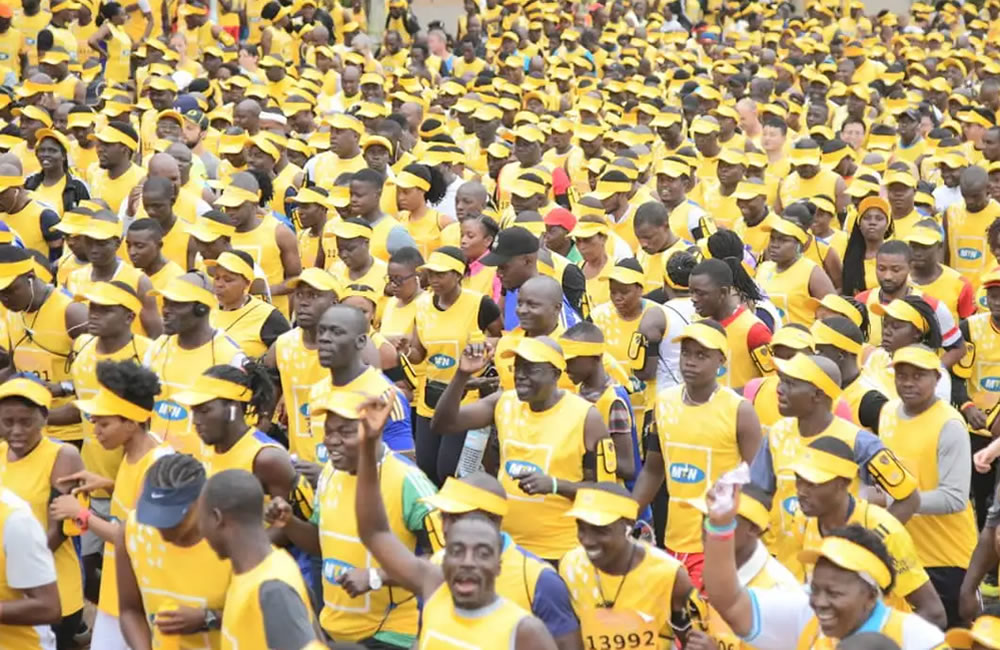
2008 MTN Kampala International Marathon Charity
The 5th edition of the MTN Kampala Marathon will take place on November 23rd 2008. In the first three editions, the proceeds from the marathon were donated to Uganda Red Cross towards the Mama Bag Appeal.
The 20 year civil war in Northern Uganda greatly undermined the public health infrastructure within the region. The Mama Bag Appeal initiative was therefore set up to provide expectant mothers living in Internally Displaced Peoples Camps (IDPs) with the basic necessities for a safe delivery. Expectant mothers were chosen because they were the most vulnerable. Over 8500 expectant mothers in Northern Uganda benefited from the proceeds of the marathon that totaled to 125 million Uganda shillings for the three years.
In 2007, peace slowly returned to the region, with many of the IDPs encouraged to go back to their homes and resettle into a normal life. The MTN Kampala Marathon donated 59 million shillings to the purchasing of a return kit to be given to families from katakwi resettling home from IDP camps. With this money, a total of 1180 kits were distributed to these families. A return kit includes farming implements, seeds, a mosquito net, among many other things.
This year, proceeds from the MTN Kampala Marathon will once again go towards purchasing return kits for families resettling in their homes within the areas of Karamoja, Kitgum, Amuria and Katakwi. The Marathon hopes to be able to purchase 2000 return kits, the cost of which is estimated at 100 million.
We cannot reverse history, but we can shape the future. Togteher we can make a difference.
MTN Kampala Marathon 2008. Run for fun, Run for life.
The marathon legend
In 490 BC, the Greeks defeated the Persians in fierce battle at a place called Marathon; In order to deliver the news of the great victory they sent a runner Pheidippides to Athens to announce the victory. He ran over a distance of roughly 42.83 Km, shortly upon arrival and delivering the good news, “Rejoice! We conquer,” he dropped dead.
Subsequently, when the first modern Olympics were held in Athens in 1896, a race was organised over the same course that Pheidippides used and thus named “The Marathon race”.
The early Olympic Games ran the Marathon over varying distances and it wasn’t till the Paris Summer games of 1924, that the standard distance of 42.195 Km was adopted and used to date.
Marathons in Uganda
The earliest marathon races held in Uganda were run in the 1920s and were organized by Officers of the Kings African Rifles in order to improve the fitness levels of the soldiers, as a result of this one of the first Ugandan Marathon routes ran between Kampala and Bombo Military Barracks.
In the subsequent years in the 50’s and 60’s when running became a popular and professional sport periodic national events began to take root and flourish. Marathons were held in Jinja, Entebbe , Lira, Arua, Mbarara and Moroto.
Unfortunately in the turbulent years from 1972 to 1987 when there was widespread persecution and disorder, organising marathons let alone any form of road-race became an impossibility.
It wasn’t till the late 80’s and the early 90’s when relative peace returned to the country that competitive road races including Marathons were organized once again. However having spent such a long period without hosting regular marathons. Local organizers faced great challenges, Sponsors were skeptical, participants limited in number and the general public uninterested.
Still through the efforts of a few committed individuals and the support of athletics officials a sprinkling of events were held in the late 80 to mid 90’s most notable amongst these was the 1991 British Airways Marathon which was the first comprehensively organized and sponsored Kampala Marathon.
In the subsequent years the Marathon reappeared as an event in the UAAF national athletics calendar both as a full 42 km event and a half marathon, however due to a lack of funds and the intensive nature of a marathon, the races were often cancelled or held under the most Spartan of conditions.
In 2004 MTN Uganda decided to widen its sports sponsorship programme. Athletics was one of the sports chosen; this was due to its wide reaching appeal and the abundance of natural running talent available. In choosing an event that would signify the intent that MTN had for athletics a decision was taken to sponsor an Inaugural Kampala Marathon. The response to this event surpassed all expectations and the inaugural MTN Kampala Marathon in 2004 drew over 1264 participants both local and international.
The actual race was won by local track star Joseph Nsubuga (fittingly a soldier) who clocked a winning time of 2:18:21 while the women’s race was won by Margaret Nakintu in a time of 3:07:17. These times though considered slow by international standards must be considered in their context, the route in Kampala “the city of seven hills” is one of the most challenging in the world.
The second edition of the MTN Kampala Marathon was dominated by Kenyans the Men’s race was won by Busienei Wilson Kipkemei who led a Kenyan clean sweep of the first three places, the time itself was disappointingly slow 2 hours 31 minutes 31 seconds, well below the previous years best set by Joseph Nsubuga.
The women’s race once again confirmed the dominance of Margeret Nakinti on the Ugandan women’s marathon scene she successfully defended her title in a time of 2:48:18. Unfortunately she will not be able to defend her title in 2006 having won the event twice and long dominated the local distance running scene she secured a sports scholarship and is now permanently based in the US.
Read More
Nnyanzi Art: Visual Feast From The Pearl Of Africa
Two artists who share the same heritage chose to share their artistic creations with the community and visitors of Whitstable from May 11th to 24th, 2005 at the Horsebridge Arts and Community Centre.
The exhibit, which attracted more than 800 visitors, showcased Nansubuga Kolawole’s poems, which successfully illustrate Nuwa Wamala Nnyanzi’s most recent works of art.
Nansubuga, is married with two children, has a bachelor’s degree in Law from the University of Bristol, UK and a Masters in Science in Development Studies. Nansubuga is a new entrant in the field of art. Nnyanzi is a veteran of twenty-six years. Nnyanzi a self-taught visual arts practitioner recently graduated with a first class MA Design (Professional Practice) degree from Middlesex University, UK.
Nansubuga grew up appreciating art and later on became a collector. Nnyanzi’s art so inspired her that not only does she collect it but promotes it too and is responsible for organizing the exhibitions. Nansubuga said that as a compliment to her cousin’s illustrious career spanning a quarter of a century, she decided to put her feelings and interpretation in poem form.
One of her poems; ‘I Will Be Here For You’ appropriately hang next to Nnyanzi’s ‘You Are My World’, a batik painting portraying a mother holding her child in a loving and tender manner. Nnyanzi’s use of mono colour and simple lines to capture motion and emotion is clearly manifest in this piece. So is Nansubuga’s choice and arrangement of words.
Another example of the successful collaboration between the two cousins is demonstrated in Nnyanzi’s ‘Gender Issues’, in which a woman clad in busuuti (one of Ugandan women’s traditional dress) is portrayed writing on a banner words, which read; ‘Empower Women.’ The same banner on the left hand side; is supported by a woman clad in munagiro (yet another Ugandan women’s traditional attire). While on the right side is a man pounding food, a role that is traditionally dominated by women. The man’s mortar is raised and at the top it serves as a flag post for the banner.
Nnyanzi’s legendary commitment to his faith also manifests itself in some pieces such as; ‘The Pentecost’, ‘Taking Care of Humanity’, ‘The Trinity’, while his pan-Africanism is vivid in: ‘African Defence Symbols’ and ‘African Connection.’
Although a pan-Africanist, Nnyanzi without apologies is proud of his roots in the centuries old kingdoms of Bunyoro Kitara and Buganda located in the great lakes region. It comes out clearly in the newly created pieces such as; ‘Mujaguzo’, ‘Emotionally Engaged’, ‘Rhythm and Emotion’, and ‘The Joy of Life.’ The two also addressed other areas in the show, which included responsible parenthood, love, royalty, effects of war, and challenges the youth face.
The art exhibit attracted a cross section of people. Basing on the comments recorded in the guest book and exchanges between guests and artists; viewers seem to have been emotionally touched. Among the visitors were children, youth, middle aged, and senior citizens. The majority of them especially those who were seeing that type of art for the first time were impressed by the application of colour, mastery of depicting motion and emotion, the choice and arrangements of words and titles.
The first weekend attracted over four hundred visitors from different parts of the world because Whitstable is a very popular tourist destination. The majority of them had no idea where Uganda is located on the map. With the help of a map and a lot of story telling they were more informed by the time they left.
A six year old girl on seeing the piece titled ‘The Pentecost’, which portrays the Apostles raising their arms to receive the Holy Spirit, while emulating the gesture she broke into a song; YMCA. It is clear that the gesture reminded her of The Village People’s song YMCA and the video clip, which shows people singing and raising their arms to form letters that make up YMCA. That was her personal interpretation.
Artists who were exhibiting in the neighboring gallery also expressed their fascination with the art they were seeing for the first time. One of them, a retired swimming pool designer described the art as; ‘Very African on the outlook yet with many key elements of European art’. He added; ‘It is very tranquilizing’.
An eighty year old woman who was the first to acquire a piece from the collection turned her bag inside out in search of money but could only come up with less than what was necessary. But she was not to be outdone. She rushed home to collect the balance. Luckily for her, on her way home she met with her husband who gave her the entire amount. As she was trying to explain to him why she desperately needed to get the art, he just waived her off saying: ‘seeing how excited you are about it. I will like it too. So go ahead and get it darling’.
Art students from the University of Canterbury also found the art show very useful in terms of exposure to new forms of art. They also saw it as a valuable resource material for their projects. A teacher of a school for disabled children booked a day to bring his students to the exhibit because he felt that they were likely to benefit from it in terms of visual entertainment and emotional therapy.
A husband to one of the artists exhibiting in the neighboring gallery described Nnyanzi’s art as graphic, colourful and very moving. He said that if he were to buy he would go for ‘At Peace With Each Other’ because of the shapes and forms, which when put together bring out how the woman and man in the piece feel about each other. The woman’s hand tenderly and possessively holds the man’s head close to her bosom. The man obligingly, with eyes closed rests peacefully and seems to be enjoying every moment of it. And the woman with her eyes closed and a faint yet revealing smile on her lips says it all.
Artist Olive Powel’s husband, a retired designer of swimming pools, on walking into the exhibition hall said he felt like collapsing in a rocking chair in front of the art pieces and taking in everything. He described the works of art as soothing and musical. He suggested to his wife that next time she felt like giving him a present she would be well appreciated if she bought him; ‘At Peace With Each Other.’
John Winston Jenkins, a trained draughtsman and visualiser who had worked for a big landscaping firm and later established his own consultancy in the swimming pool industry found Nnyanzi’s art refreshing.
Michael Stringer aged 71, retired designer and painter, and a remarkable storyteller described Nnyanzi’s art as very African and detected some resemblance with the French artist whom he believes influenced Pablo Picasso. Unfortunately he could not recall his name. But he promised to go and find out from the library where he had seen it. With his walking stick he slowly made his way to the library and was back later with the name and an interesting story to tell. The name of the artist happened to be Ferdinand Leger. He talked about a book on the lives of Picasso, Braque and another famous French artist whose art Picasso did not want to compare with his. But on the author’s insistence, at the breakfast table Picasso leaned forward, both hands on his cheeks and blurted out ‘That bastard can paint.’
The most popular pieces in the exhibit were: ‘At Peace With Oneself’ and ‘Outdoing Each Other.’
The work reminded Peter Hackford of Egypt where he had come across the quote’ I hold you in my heart like a reed in the arms of the wind’ To him the curves and embrace were a show of love.
All in all the exhibit was successful in terms of exposure and there is need for a more exhibits in future to make the people more familiar with our art. As a result more people may develop a taste for our art to the level of acquiring it. With the policy of fair trade being promoted by European countries it is likely that the visual arts industry will benefit greatly from the move. Besides it is high time Uganda contributed to global culture instead of just being consumers.
All the new pieces on show plus others, which are yet to be revealed to the public will soon be posted on; www.nnyanziart.com
Read MoreTooro Kingdom: A Sneak Peek
In the South Western part of the country, adjacent to the Great East African Rift Valley’s western arm, at the foot of the magnificent Rwenzori ranges, the �Mountains of the Moon�, lies one of Africa’s oldest societies.
It is recorded that until the 1830s, Tooro was part of Bunyoro-Kitara, one of the ancient kingdoms in this region. In 1836 Olimi Kaboyo the son of Kyebambe III Nyamutukula of Bunyoro-Kitara, set up Tooro as an independent Kingdom. However, in 1867 Kabalega was crowned king of Bunyoro- Kitara and invaded Tooro under the reign of Nyaika Kasunga, the son of Kaboyo 1. Nyaika had just assumed power after killing his brother Rukidi I. British colonial era set in at the time as 1891 saw the arrival of Lugard with his intimidating Maxim gun. He promptly installed the young Kasagama as King Kyebambe IV of Tooro.
Abwoli Kansiime is from Tooro, she echoes nearly 90 percent of Batooro sentiments and mannerisms you come across on any given street, even with her university education. �Something deep inside me was moved beyond words,� she said. �When they said we now have our king, it was like my spirit was lifted way up and there and then the kingdom was a part of me.� Abwoli recalled the restoration of kingdoms in 1995 with a glittering face, voice stuttering and glistening eyes. A warm smile spreads all over her beautiful face as she falls back in deep thought. Approaching her mid forties now, Abwoli was in her teens when the Uganda government, under Milton Obote, abolished all kingdoms in 1966.
Libya�s President Ghadaffi has turned out to be a blessing to the kingdom under the reign of twelve-year-old King Oyo Nyimba Iguru. Ghadaffi has funded the rehabilitation of the palace plus additional contributions to this kingdom.
Those watching Ghadaffi in Tooro continue to miss the cue to what seems to be an earnest search of cultural rebirth. All the speculations are clouded in the stunning beauty of the Batooro, saying that he has been stricken by the exquisite looks of Tooro Queen Mother Best Kemigisa, romantically linking them together. She dispels the speculations saying that they just happen to be friends and that that is why Tooro now has a beautiful palace.
Still recovering from years of neglect as a kingdom, the Batooro now face the same questions being asked by other kingdoms. Where to place these cultural institutions in Uganda’s regional governments? Will it work and what will it mean for the Batooro?
Read More